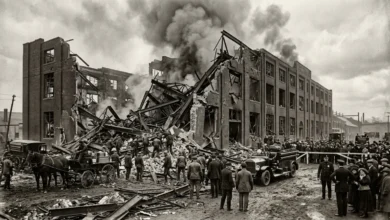
Inside the Deadliest Mining Disaster Textbooks Left Out
Monongah 1907: America's Deadliest Mining Disaster

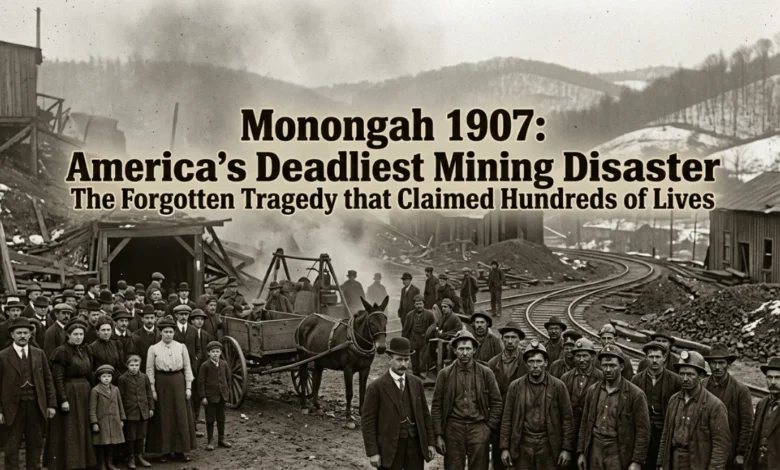
Just after 10 o’clock on the morning of December 6, 1907, the ground shook in Monongah, West Virginia, and a sound rolled out across the hills that people miles away would later say they felt as much as heard. Underground, in a connected network of tunnels beneath the town, something had gone catastrophically wrong inside the Fairmont Coal Company’s No. 6 and No. 8 mines. Above ground, the blast was strong enough to collapse mine entrances, hurl debris and choking smoke into the air, and send families running toward the pit head before anyone official could tell them what had happened. By the time the smoke cleared, more people had died in that single morning than in any mining disaster before or since in American history, and most of the country would spend the next century barely aware it had happened at all.
A Company Town Built on Immigrant Labor
Monongah sat in Marion County, in north-central West Virginia, along a stretch of the Monongahela coal fields that had turned the state into one of the country’s leading coal producers by the turn of the twentieth century. The town existed almost entirely because of the mines. Its two connected shafts, known simply as No. 6 and No. 8, were operated by the Fairmont Coal Company, part of a rapidly consolidating coal industry that was pulling labor into West Virginia from across the Atlantic. Company recruiters and word-of-mouth networks brought thousands of immigrants into the region’s coalfields, and by 1907 the workforce at Monongah reflected that in full: large numbers of Italian, Hungarian, Russian, and Polish miners, many of them recent arrivals who’d left villages and towns across southern and eastern Europe to work underground for wages that were still better than what they’d left behind.
West Virginia in this period had a mine death rate higher than any other state in the country, a statistic tied directly to how little regulation existed around ventilation, lighting, blasting, and general safety practice in an industry expanding faster than anyone was working to make safe. Miners were paid by the ton of coal they brought up, not by the hour, which created a powerful incentive to move fast and move often, an incentive that extended, in practice, to bringing children into the mines alongside their fathers and older brothers to help hit tonnage targets. Boys as young as eight were reportedly among those working underground at Monongah, a detail that would matter enormously once officials tried to count the dead, since these children were often never formally on any payroll or registry to begin with.
The Morning of December 6
The exact sequence of events that triggered the explosion at Monongah has never been fully settled, and it’s worth being honest about that rather than picking the most dramatic version and presenting it as fact. Investigators at the time and historians since have pointed to several possible triggers: an underground train derailment that may have severed an electrical line or struck something combustible, a blasting operation that went wrong, or simply an open-flame lamp of the kind still common in mines of that era, any of which could have ignited pockets of methane gas that in turn set off the far more volatile coal dust suspended throughout the tunnels. No single explanation was ever definitively proven, and the Monongah mining disaster remains, in that specific sense, an unsolved case sitting inside a well-documented tragedy.
Whatever ignited first, the effect was catastrophic and nearly instantaneous. The explosion tore through both connected mines, destroying the ventilation system that would normally have cleared dangerous gases from the tunnels, and collapsing sections of the mine entrances themselves. Because the two mines were linked underground, the blast that started in one appears to have traveled into the other, multiplying the area affected and the number of men and boys caught inside. Most of those killed died in the initial explosion itself; the miners who survived the first moments faced a second, slower death from suffocation and gas poisoning in a mine whose air system had just been destroyed. Reports from the era describe only a small handful of workers escaping the mine alive, with sources differing on the exact number and on whether all of those survivors ultimately lived, [VERIFY: precise number of miners who escaped the initial blast and their long-term fates, since accounts vary between roughly four survivors and slightly different outcomes for each].
A Rescue Effort Built From Nothing
There was, in 1907, no organized system of trained mine rescue teams anywhere in the United States, a gap in the country’s industrial safety infrastructure that Monongah would help expose. What rescue effort existed at Monongah came together improvised, in real time, out of whoever could reach the site fastest. Miners from neighboring communities in Pennsylvania, Maryland, and Ohio began arriving within hours, many of them fellow immigrants themselves, willing to go underground into a mine that had already killed hundreds of people that same morning in order to bring out bodies, and in a handful of cases, survivors.
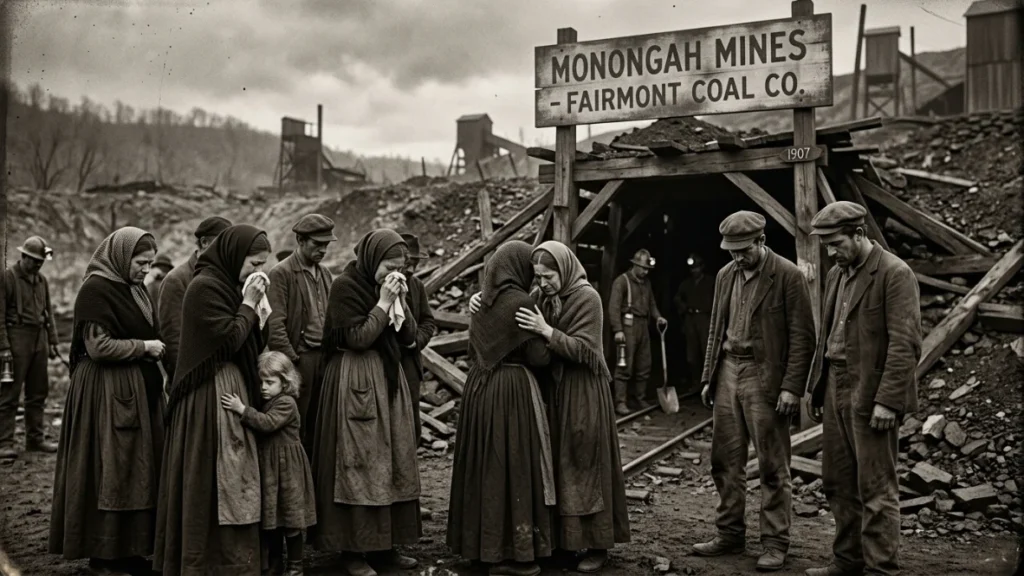
What they found and carried out was, by every surviving account, horrific. The force of the blast had killed many miners outright and mutilated others beyond easy recognition, and the recovery effort stretched on for days as crews worked through collapsed and gas-filled tunnels. Above ground, the town’s capacity to handle what was coming out of the mine buckled almost immediately. Embalmers worked continuously, and caskets reportedly lined both sides of Monongah’s main street as funeral services stretched on for days at a time. At the mine entrance itself, women who had lost husbands, sons, brothers, and in some cases multiple family members simultaneously, gathered in states of grief severe enough that accounts from the time describe some of them being physically restrained from throwing themselves in front of passing trains and streetcars in the disaster’s immediate aftermath.
Counting the Dead
The official death toll from Monongah has generally been recorded at 361 or 362 men and boys, figures that come from company and county records compiled in the disaster’s immediate aftermath. Almost every serious historian of the disaster, however, treats that number as a floor rather than a ceiling. The reasoning is straightforward once you understand how the mine’s workforce actually operated: an unknown number of children and other unregistered workers were underground that morning helping relatives meet tonnage quotas, and because they were never on any official employment roster to begin with, there was no clean way to count them among the missing once the mine’s own records and identification systems had been destroyed in the same blast that killed them. Historian J. Davitt McAteer, who spent nearly three decades researching the disaster, has put the true total closer to 500 men and boys, and some later estimates pushed even higher during the disaster’s centennial commemorations in the mid-2000s.
That said, the historical record here cuts in more than one direction, and it’s worth noting the correction as much as the inflation. Research published by historian Joseph Tropea examining the disaster’s documentary record has pushed back specifically on some of the higher, more dramatic casualty figures that circulated during the centennial, arguing that certain claims of hundreds of additional unreported victims, sometimes described in later retellings as entire uncounted families, don’t hold up against the available archival and genealogical evidence, and that some of these figures appear to have been embellished well after the fact rather than documented at the time. The honest position, then, is that the real death toll at Monongah almost certainly exceeds the official count of 361 or 362, but that exactly how much higher it climbed, whether into the low 400s or as high as 500, remains genuinely disputed among researchers rather than settled, [VERIFY: most credible current scholarly estimate of the total Monongah death toll, given the range between official records and later historical revision].
What Was Left Behind
Whatever the precise final number, the disaster’s toll on the surviving families was immediate and severe. Widely cited figures put the number of new widows at around 250, and the number of children left fatherless somewhere between 500 and 1,000, a range that itself reflects how many households in Monongah had multiple men working the same shift. One frequently repeated detail from the disaster’s aftermath holds that, on a single block in town, only three households out of thirty still had a living adult man left in them.
A national relief effort followed quickly. Roughly 2,000 American newspapers ran appeals on behalf of the Monongah widows and orphans, and the resulting fund raised something in the neighborhood of $150,000, with industrialist Andrew Carnegie among the more generous individual contributors and the Fairmont Coal Company itself putting in a reported $17,500. Divided among hundreds of families, that money didn’t go far: individual payouts were commonly cited at around $200 per widow and roughly $155 per orphan under the age of sixteen, [VERIFY: exact per-family relief payout figures, since several distinct sourcesuse slightly different numbers for the widow and orphan amounts]. For some families, particularly those with closer ties to relatives back in Italy, the disaster’s financial and emotional toll was severe enough that they chose to leave Monongah entirely, with some Italian widows eventually repatriating to Italy rather than remaining in the community where they’d lost so much.
The dead themselves posed their own logistical crisis. So many bodies were unidentifiable, and so many families had no surviving members left in Monongah to claim them, that the Fairmont Coal Company donated a plot of land for an expanded cemetery, where 135 unidentified victims were ultimately buried together in a mass grave, [VERIFY: exact figure for the number of unidentified victims interred in the Monongah mass grave].
Black December
Monongah did not happen in isolation, and understanding why it slipped out of the national memory the way it did requires understanding what else was happening in American coal country that same month. In the weeks following the December 6 explosion, several other major mine disasters struck coalfields elsewhere in the country, part of a stretch grim enough that December 1907 came to be remembered among mining historians as “Black December.” By the time the year closed out, more than 3,200 American miners, some tallies put the figure at 3,241 or 3,242, had died on the job in 1907 alone, making it the deadliest single year in the history of American mining. Monongah was the worst single incident within that terrible year, but it was competing for public attention against a genuine wave of industrial catastrophe rather than standing alone as an isolated horror, which may be part of why it never lodged itself in the national memory the way single, more isolated disasters sometimes do.
The scale of loss across the industry that year did eventually feed into real, if slow-moving, reform. The disaster at Monongah is widely cited as one of the contributing pressures behind the creation of the United States Bureau of Mines in 1910, the country’s first dedicated federal agency focused on mine safety research and standards. Broader change came slower still, pushed forward over subsequent decades by the United Mine Workers of America and sympathetic state legislators, and historians researching the disaster have traced a direct line from Monongah all the way to the Federal Coal Mine Health and Safety Act of 1969, more than sixty years after the explosion that helped set that long regulatory arc in motion.
What Remains in Monongah
Monongah itself never stopped being a small town, and for much of the twentieth century, the disaster that had defined its worst single morning went largely unmarked by any physical monument at all. That changed gradually, driven in large part by the efforts of a local Catholic priest and disaster historian, Father Everett Francis Briggs, who spent much of his life documenting the event and trying to identify miners who had never been formally accounted for. In 2007, on the disaster’s centennial, the town unveiled the Monongah Heroine, a marble statue honoring the miners’ widows, modeled in part on the story of a woman named Caterina Davia, whose husband’s body was never recovered from the mine and who reportedly spent nearly three decades afterward carrying sacks of coal from near the mine site back to a growing pile at her own home, a private ritual of grief that outlived her and became part of local memory. That same centennial year, the Italian region of Molise, home to many of the miners who had emigrated from villages across southern and central Italy, presented Monongah with a bell that now sits in the town square, a physical link between a small West Virginia coal town and the specific Italian communities whose men never came home.
The West Virginia Mine Wars Museum today uses Monongah as the starting point for a broader public history of mine safety and labor struggle in the state, one that runs forward through later disasters and labor conflicts up through the Upper Big Branch mine explosion of 2010, [VERIFY: exact framing and details of how the Mine Wars Museum’s exhibit connects Monongah to Upper Big Branch and other later disasters]. Part of that installation uses 362 individual metal check tags, mirroring the identification tag systems mines eventually adopted partly because of disasters like Monongah, one tag for each officially recorded victim, a quiet acknowledgment that the true number was almost certainly higher and will likely never be known with precision.
Monongah rarely appears in the general American history taught in most classrooms, despite remaining, by any accounting, the deadliest single mining disaster in the nation’s history. Part of that absence is explainable by timing, buried as it was inside a month and a year already crowded with industrial catastrophe. Part of it is explainable by who died: immigrant laborers and their children, working in a company town far from the country’s centers of media and political power, at a moment in American history when that kind of death drew a fraction of the sustained attention it would draw today. What’s left in Monongah now is a cemetery with a mass grave still holding unidentified dead, a marble statue of a woman who spent decades carrying coal home from the mine that killed her husband, a bell from a province in Italy that lost its own sons to a shaft on the other side of the ocean, and a question that historians still can’t fully answer: not just how the fire started underground that morning, but exactly how many people it actually killed before it was finally over.