
The funeral took a full day to get through. On April 13, 1917, twelve thousand people packed into Chester Rural Cemetery in Delaware County, Pennsylvania, to bury the dead from a factory explosion that had torn through a munitions plant three days earlier. Fifty-five of the coffins held no names. The bodies inside them had been too damaged, or too scattered, for anyone to identify who they’d been in life. They went into a mass grave with a small stone marker, and that marker is still there today, in a cemetery in a town most Americans have never heard of, for an event most American history books never mention at all.
The plant was in Eddystone, Pennsylvania, a small borough on the Delaware River just south of Chester. The date was April 10, 1917. Four days earlier, the United States had formally declared war on Germany. Not a single American soldier had yet set foot on a European battlefield. But 133 people were already dead in a Pennsylvania factory, and depending on which contemporary account you trust, as many as 150 may have died, in what several historians have since argued were among the first American casualties of the First World War, killed before the country had sent a single man overseas to fight it.
A Locomotive Company Starts Making Shells
The plant belonged to the Eddystone Ammunition Corporation, a subsidiary set up by the Baldwin Locomotive Works, which under ordinary circumstances built trains. War changes what a factory makes. By 1914, Britain, France, and Imperial Russia were desperate for manufacturing capacity they didn’t have at home, and American industrial firms with idle capacity started signing contracts to produce war materiel for foreign governments even before the U.S. itself had entered the fighting. Baldwin took contracts to build rifles and artillery shells. The Eddystone plant, built in 1916 specifically for this purpose, was reportedly turning out shrapnel shells under contract for the Russian army [VERIFY: precise terms and buyer of the Eddystone shell contract, described in some sources as supplying the Russian Imperial or “White” army].
A shrapnel shell isn’t like the high-explosive shells most people picture from World War I. Instead of a single blast, it used a timed fuse to burst in midair over enemy soldiers, scattering roughly 250 lead or steel balls downward like a shotgun blast from above. Building one meant assembling a brass shell casing, packing it with a black powder charge, and loading the shrapnel balls on top, all careful, repetitive, hands-on work. At Eddystone, most of that work was done by women and girls. Roughly 380 of them staffed the plant’s “F” Building, the structure where shells were loaded, on the morning everything went wrong.
The Morning of April 10
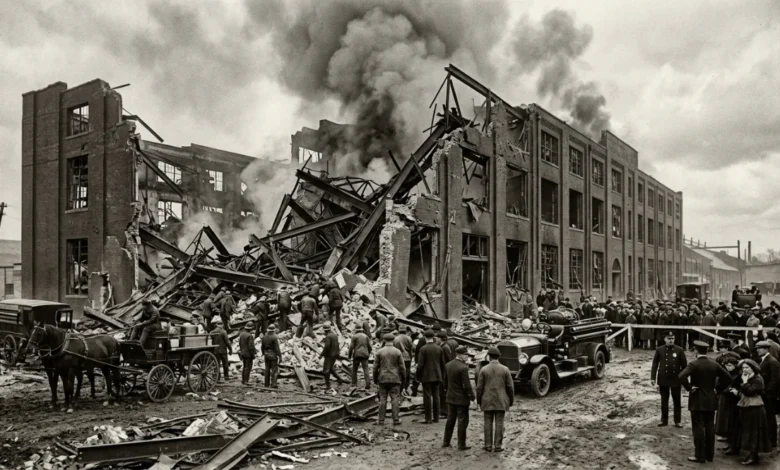
It was a Monday, just before 10 a.m. According to newspaper accounts from that week, roughly 18 tons of black powder propellant stored in the building somehow ignited, setting off a chain of detonations, first one large explosion, then two smaller ones in quick succession, that tore the F Building apart. The blast was strong enough to be felt for miles, rattling windows in boroughs well outside Eddystone itself.
What followed was chaos of the kind that’s hard to convey in a summary. Workers ran for exits that many of them never reached. Some bodies were later found in the nearby Delaware River, and no one could say for certain whether those workers had fled there seeking safety from the fire, or had been thrown into the water by the force of the blast itself. Fragments of bodies were found scattered across a wide radius around the plant. Cadets from the nearby Pennsylvania Military College, about a hundred of them under the command of a Captain Lewis Morey, rushed to the scene and spent more than five hours helping hold back the panicked crowds trying to push into the plant yard looking for missing relatives. Local hospitals in Chester filled past capacity almost immediately, and the Sixth Regiment Armory in Chester was converted into a makeshift emergency ward to handle the overflow of injured.
The first newspaper reports out that afternoon undercounted the dead, as tends to happen in the immediate aftermath of a disaster of this scale. Early wire copy put the toll at 50 or 60 killed. By the next day the number had climbed past 100. Within the week, most accounts had settled on 133 confirmed deaths, though period sources continued to cite figures anywhere from just over 100 to nearly 150, and no single, final, universally agreed number exists even now [VERIFY: whether any later official government or company accounting settled the death toll more precisely than the 119–150 range reported in contemporary press].
An Unsolved Cause
In the first hours after the explosion, almost everyone assumed sabotage. The United States had entered the war against Germany only four days earlier, and a munitions plant blowing up immediately afterward looked, to the people living through it, like exactly what an enemy agent would want. Newspapers ran headlines about German plots. Investigators detained suspects. Within months, the theory shifted: some officials began to suspect Russian nationals working at the plant instead, reasoning that opponents of the czarist government, which the shells were bound for, might have had motive to sabotage the shipment.
Neither theory was ever proven. No one was ever convicted of causing the Eddystone explosion, and the more mundane explanation, that malfunctioning equipment or an accidental spark set off the black powder during ordinary loading operations, has never been ruled in or ruled out either. It’s one of the case’s more uncomfortable open questions: a disaster that killed well over a hundred people, in wartime, at a plant making munitions for a foreign government, and nobody was ever held responsible for why it happened, because nobody could ever prove what actually caused it.
Burying the Dead
What the company could do was pay for funerals, and it did. The Eddystone Ammunition Corporation covered the full cost of burial services for the victims, including the mass service held on April 13 at Chester Rural Cemetery, where an estimated 12,000 mourners gathered, described at the time as one of the largest funeral gatherings the cemetery had ever hosted. Fifty-two unidentified bodies were interred there that day; three more were added later, bringing the total in the unmarked communal grave to 55. A modest monument near the Edgmont Avenue side of the cemetery marks the spot today, and by some accounts people still occasionally leave small tributes there, likely descendants of workers whose identities were never recovered.
Six days after the disaster, President Woodrow Wilson delivered a public address that touched on the explosion’s larger context, framing industrial workers, men and women alike, as an essential part of the nation’s wartime effort. It was a dignified enough gesture, but it also underlines something uncomfortable about how quickly the country moved past what had happened. Within two weeks, the Eddystone plant itself was back in production. The war absorbed the story. There was, after all, an actual war going on, with its own casualties accumulating by the day, and a factory explosion in a small Pennsylvania borough, however many people it had killed, didn’t compete for long with headlines about troop mobilizations and shipping losses at sea.
What Eddystone Looks Like Now
The plant itself is long gone. The land where it once stood, along the Delaware River in Delaware County, is now occupied by the Eddystone Power Station [VERIFY: current operational status of the Eddystone Power Station site, as power facilities in this area have changed ownership and use over recent decades]. There’s no large public memorial at the former plant site itself, nothing that would tell a passerby that more than a hundred people died there in a matter of seconds on an April morning in 1917. The only physical marker tied directly to the event sits in the cemetery a few miles away, over a grave for people whose names were never recovered.
It’s worth sitting with why this disaster faded the way it did, when other industrial tragedies from the same era, the Triangle Shirtwaist Factory fire in New York a few years earlier, for instance, became fixed points in American labor history. Part of it may simply be timing: Eddystone happened in the opening days of America’s entry into the largest war the country had ever fought, and it got swallowed by everything that came after. Part of it may be that the workers who died were producing shells for a foreign government’s army, which complicates the kind of clean national narrative that tends to keep a disaster alive in public memory. And part of it is probably just the ordinary erosion of time working on an event that never had a definitive villain, a completed investigation, or a piece of legislation named after it. There was no trial. There was no reform movement that traces its origin cleanly back to this one morning. There was a mass grave, a monument, and then, within two weeks, a factory back at work.
What’s left is the record itself: a small borough on the Delaware River, a company that no longer exists, roughly 380 women and girls working in a single building loading shells by hand, and 133 of them, give or take, who never went home that Monday. The question of exactly what set off the black powder that morning is still, more than a century later, unresolved. So is the question of exactly how many people the blast actually killed. Both of those unknowns are part of the story now, as permanent as the monument in Chester Rural Cemetery marking the grave of the fifty-five nobody could name.