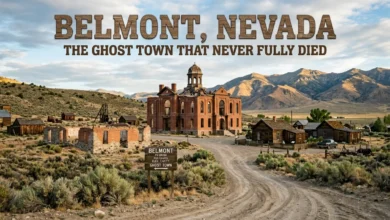

The bank is the first thing you notice, because it’s the only thing still standing at full height. Three stories of poured concrete and dressed stone, empty window frames staring out at nothing, in a stretch of the Nevada desert where the nearest working traffic light is twenty-some miles away. There’s no town around it anymore. No streets, no other buildings taller than a foundation line in the dirt. Just the bank, a train depot, a house built entirely out of glass bottles, and the wind.
Ten years before that bank went up, there was no town here at all. Ten years after it opened, there was almost nobody left to make a deposit.
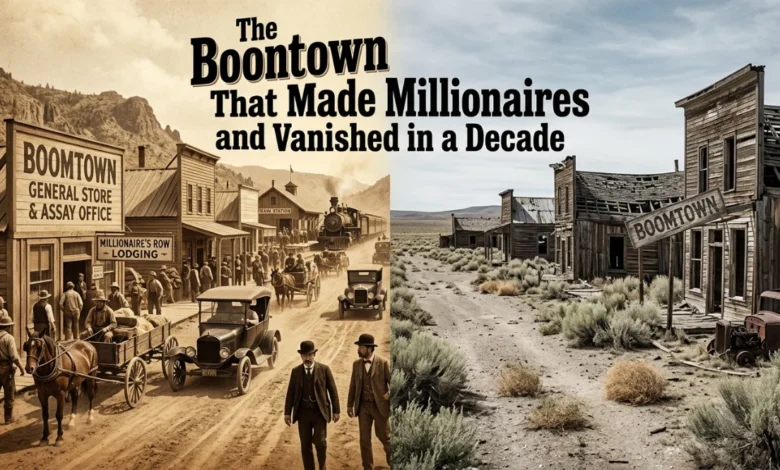
This is Rhyolite, in Nye County, Nevada, in the Bullfrog Hills a few miles from the eastern edge of what’s now Death Valley National Park. For a short stretch in the early 1900s, it was one of the biggest towns in the state, with electric lights, a stock exchange, an opera house, and at least one steel magnate’s money running through its mines. Then the gold got harder to reach, the credit dried up, and the whole place came apart faster than it had gone up.
Gold in the Bullfrog Hills
The story usually starts with two men and a burro. In August 1904, prospectors Frank “Shorty” Harris and Ed Cross were working the desert country west of Death Valley when they found gold-bearing quartz veined with a greenish rock that reminded someone of a bullfrog’s back. The name stuck to the whole district. Within weeks, word of the strike had pulled in prospectors from Tonopah and Goldfield, the two big Nevada camps to the north, and a scatter of tent settlements went up around the find. One of them, a few miles from the original discovery, took its name from the pale volcanic rock in the surrounding hills: rhyolite.
By early 1905, Rhyolite was pulling ahead of its neighbors. It sat closer to the richest claims, including one that would become the Montgomery Shoshone Mine, named for prospector Bob Montgomery, who had staked it. Investors noticed. Within two years the town had three competing railroads racing to lay track to it: the Las Vegas and Tonopah, the Bullfrog Goldfield, and the Tonopah and Tidewater. Getting a rail line to a desert mining camp in 1907 wasn’t cheap, and nobody spends that kind of money on a place they expect to fold in a few years. That’s what makes what happened next worth sitting with.
A City Built on a Few Years of Ore
At its peak, probably somewhere between 1907 and 1908, Rhyolite had a population that estimates put anywhere from a few thousand to close to ten thousand people [VERIFY: exact peak population figure, sources vary widely]. Whatever the true number, it was enough to support a hospital, a school, several churches, an opera house, at least three newspapers, and a red-light district down by the tracks. There was a stock exchange building where shares in local mines changed hands, an ice plant that briefly made the desert bearable, and, by 1907, electric streetlights running down the main road. A telephone exchange connected Rhyolite to the outside world faster than the mail could.
One of the odder landmarks from this stretch is still standing: the Bottle House, built in 1906 by a miner named Tom Kelly, who used somewhere around 50,000 discarded beer and liquor bottles in place of lumber, which was scarce and expensive to haul in [VERIFY: exact bottle count and full construction date]. It’s the kind of detail that sounds like a folk tale until you’re standing in front of it, and it’s one of the few structures in Rhyolite that a modern visitor can still walk into.
The money that built the rest of the town, though, came from further away than the local mines could really justify on their own. In 1906, Charles M. Schwab, the steel executive who had run Carnegie Steel and would go on to found Bethlehem Steel, bought a controlling stake in the Montgomery Shoshone Mine. Schwab poured money into infrastructure: a water pipeline, better milling equipment, and the kind of publicity that drew East Coast investors into a mining district most of them would never see in person. For a couple of years, that investment made Rhyolite look less like a mining camp and more like a small city that happened to be sitting in the desert.
The Ground Runs Out
Nobody in Rhyolite in 1908 thought the town had only a few years left. But two things were working against it at the same time, and neither one had an easy fix.
The first was geological. The richest ore near the surface, the kind that had drawn the original rush, was limited. As the mines dug deeper, the gold that came out was lower grade and more expensive to process, and the returns started shrinking even as costs held steady or climbed.
The second was financial, and it hit the whole country at once. The Panic of 1907 tightened credit nationally, and mining ventures that depended on a steady stream of outside investment felt it hard. Rhyolite’s mines needed continued capital to keep operating at scale, and that capital got harder to find right as the ore itself was getting harder to profitably extract. It’s not accurate to say the panic alone killed Rhyolite, or that declining ore grades alone did it. The two problems arrived together and reinforced each other, and the historical record doesn’t cleanly separate which one mattered more.
By 1910, the Montgomery Shoshone Mine’s output had fallen off sharply. The mine closed in 1911 [VERIFY: exact closure date], and without it, there wasn’t much reason for the rest of the town to stay. Banks pulled out. The newspapers folded one after another. People who had built lives around a mining boom that seemed permanent packed what they could and left for Goldfield, or Tonopah, or somewhere further off entirely. By the 1920 census, the town’s population had dropped to a small fraction of its peak, and within a few more years it was effectively empty [VERIFY: 1920 census population figure]. The last passenger rail service to Rhyolite ended not long after, and the tracks themselves were eventually torn up for scrap.
Fewer than twenty years passed between Shorty Harris’s discovery and the town’s collapse into a scatter of ruins.
What’s Left, and What’s Still Argued Over
What remains today sits just off the highway between Beatty, Nevada, the nearest town that’s still inhabited, and the edge of Death Valley National Park. The bank building is the tallest surviving structure, its concrete shell open to the sky. The old train depot, built for one of the three competing rail lines, still stands more or less intact and has been used over the decades for various purposes, including as a private residence at one point. The jail is there. Foundations trace out where the school and the opera house used to be, if you know where to look.
Right at the edge of the townsite is the Goldwell Open Air Museum, a small collection of outdoor sculptures started in 1984 by Belgian artist Albert Szukalski, whose ghostly plaster rendition of “The Last Supper” has become one of the more photographed pieces of desert art in the state. It’s an odd, fitting neighbor for a ghost town: an art installation about absence, standing next to a real one.
There’s still no full agreement on exactly how big Rhyolite got at its height, or how much of its brief prosperity was built on genuine ore reserves versus speculative capital chasing a story that Wall Street wanted to believe. What’s clear is that for a handful of years, a patch of desert that had never seen a permanent settlement supported thousands of people, three railroads, and a working stock exchange, and then didn’t. The bank still standing out there, roofless and alone, is about as direct a record of that as you’re likely to find.