Ghost Towns of West Virginia’s Coal Country
Where the Railroad Still Runs Through an Empty Town

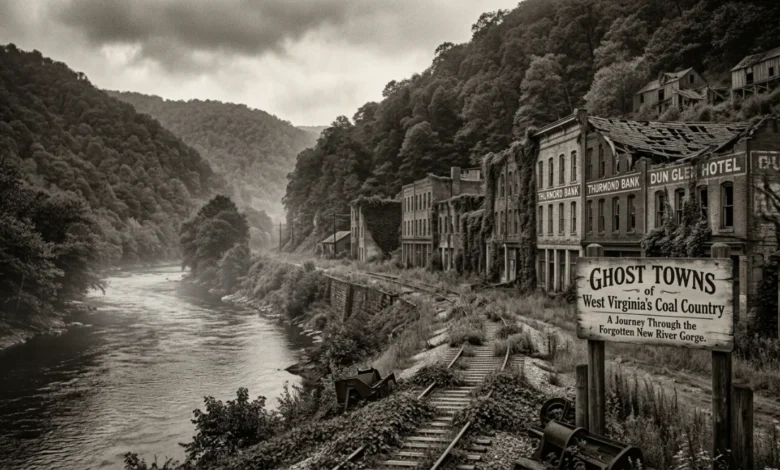
The train still stops at Thurmond, but almost no one is waiting.
Steel rails curve beside the New River, squeezed between dark water and the steep, wooded walls of the gorge. Across the tracks stand brick commercial buildings from another age: a bank, hotel, engine house, and storefronts facing what once passed for the town’s main street. There is no broad avenue through Thurmond, no courthouse square, and little room for either. The railroad was the street. Coal trains were the town’s pulse.
A visitor arriving in Fayette County, West Virginia, can stand beside the restored Chesapeake & Ohio Railway depot and imagine the place when locomotives hissed beneath clouds of steam, hotel rooms filled with traveling businessmen, and miners from nearby camps came into town with wages in their pockets.
Then the train moves on. The sound recedes into the gorge, and the silence returns.
Thurmond is commonly called a ghost town, though the description is not exact. A handful of people have continued to live within its boundaries, and trains still use the line. The National Park Service preserves much of the historic district as part of New River Gorge National Park and Preserve.
That ambiguity makes it an ideal doorway into the ghost towns of West Virginia.
Across the state, communities appeared where coal seams, timber stands, and railroad tracks made settlement profitable. Some lasted generations. Others vanished almost as quickly as they had been built. When mines closed, forests were exhausted, or rail operations changed, the economic reason for the towns disappeared. Houses were removed, stores were shuttered, and roads slipped beneath vegetation.
What remains is not one ghost-town story but a whole abandoned geography: Nuttallburg and Kaymoor in the New River Gorge, Sewell along inaccessible railroad tracks, old logging settlements in the highlands, and scores of coal camps whose names survive on maps long after their buildings have gone.
Their ruins reveal how industrial West Virginia was assembled—and how thoroughly a company could dismantle a community when the work ended.
Towns Built Before They Had Time to Become Towns
Before large-scale industrial development, much of West Virginia consisted of farms, river settlements, and small mountain communities connected by difficult roads. That began changing rapidly in the late 19th century as railroads opened remote coalfields to commercial mining.
The railroad did more than serve existing towns. It made entirely new ones possible.
A mining company that opened a shaft in an isolated hollow needed workers close at hand. It built rows of houses, often on narrow benches cut into hillsides. A company store supplied food, clothing, tools, and household goods. A school, church, post office, boardinghouse, and doctor’s office might follow.
The result looked like a town, but in many cases it had no independent municipal government. The company owned the houses, commercial buildings, streets, and sometimes the utilities.
These settlements were usually called company towns or coal camps. Before the Great Depression, more than 90 percent of miners in southern West Virginia reportedly lived in company-owned communities. The arrangement offered housing and services where none had existed, but it also gave employers extraordinary power over daily life.
A miner could depend on the same company for his job, home, groceries, medical care, and access to transportation.
The camps were not socially uniform. Industrial expansion drew longtime mountain families as well as African American workers from the South and immigrants from Europe. In places that had previously been sparsely populated, coal companies assembled communities containing languages, religions, and customs from far beyond Appalachia.
Those settlements could feel permanent while a mine was productive. Children were born there. Baseball teams formed. Churches held funerals and weddings. Families planted gardens behind rented houses and developed attachments to places that technically belonged to corporations headquartered elsewhere.
Yet the town’s future remained tied to the mineral beneath it.
When a coal seam became unprofitable, a company consolidated operations, or machinery reduced the need for labor, the town could lose its purpose. The same power that had raised houses in a hollow could order them sold, moved, or demolished.
A community that had taken on the emotional weight of a hometown could disappear as an item on a corporate balance sheet.
West Virginia’s ghost towns are the physical remains of that arrangement.
Thurmond and the Money Moving Through the Gorge
Thurmond was different from a typical coal camp. It was not built around one mine. It became a commercial and railroad center serving many mines along the New River.
Captain William D. Thurmond acquired land in the area after the Civil War and gave the community his name. The Chesapeake & Ohio Railway reached the New River coalfields in the 1870s, linking remote mining operations to national markets.
Thurmond’s location made it a natural place for railroad facilities, freight operations, hotels, banks, and businesses catering to the coal trade.
[VERIFY: The precise year William D. Thurmond acquired the land and the date the settlement formally adopted his name.]
The town’s geography produced its unusual shape. With little level ground between the river and the mountain, commercial buildings faced the tracks rather than a conventional road. Passengers stepped from trains almost directly into the business district.
During its busiest years, Thurmond handled substantial rail traffic and large amounts of money associated with the surrounding coal industry. The town became known for the grand Thurmond Hotel and later the Hotel Mankin, as well as banks, restaurants, saloons, and gambling rooms.
One of its most famous establishments was the Dunglen Hotel, located across the river. Later accounts associated the Dunglen with drinking, gambling, and a long-running poker game, though some colorful claims about the hotel may have grown in the retelling.
[VERIFY: Contemporary documentation for claims about the Dunglen Hotel’s gambling activity and the duration of its reputed poker game.]
Thurmond’s decline did not come through a single dramatic catastrophe. It arrived in stages.
Road travel reduced dependence on passenger trains. Diesel locomotives required fewer servicing facilities than steam engines. Coal operations changed or closed. Fires destroyed prominent buildings, including the Dunglen Hotel in 1930. Businesses lost customers, families moved away, and the railroad workforce diminished.
The process took decades, which is one reason Thurmond remains so visually striking. Its business district did not disappear beneath a reservoir or collapse in one fire. Enough remained for the National Park Service to preserve a recognizable townscape.
The depot now serves as a visitor contact station, and the old commercial buildings stand beside active tracks.
Thurmond feels like a town interrupted rather than erased.
Elsewhere in the gorge, abandonment was more complete.
Nuttallburg Beneath the Conveyor
Northwest of Thurmond, along a steep section of the New River Gorge, the ruins of Nuttallburg descend from the mine opening toward the railroad.
English-born entrepreneur John Nuttall began developing coal operations in the area during the 1870s. A settlement grew around the mine, eventually including housing, a store, schools, churches, and industrial structures.
By the turn of the 20th century, Nuttallburg had become a busy mining community. It continued operating after Nuttall’s death in 1897 under the direction of his heirs.
The town occupied difficult terrain. The mine entrance stood high above the river, while the railroad ran along the bottom of the gorge. Coal had to be moved down the mountainside to the tipple, where it could be sorted and loaded into railcars.
The surviving conveyor and tipple give Nuttallburg its distinctive appearance. The long industrial line cuts diagonally across the forested slope, a rusting connection between the mountain and the tracks below.
In the 1920s, the town attracted national attention when automobile manufacturer Henry Ford leased the Nuttallburg mines. Ford pursued vertical integration, attempting to control the raw materials needed for his factories rather than depending entirely on outside suppliers.
Coal from West Virginia could help fuel the steelmaking operations associated with automobile production. His involvement was significant but brief; the lease did not turn Nuttallburg into a lasting Ford industrial center.
Life in the community reflected the racial and occupational divisions common in coal country. African American miners formed a substantial part of the population in some New River Gorge settlements. Housing, schools, churches, and social life could be segregated even while men worked within the same industrial system.
The mine passed through multiple owners and continued operating until the middle of the 20th century.
[VERIFY: Nuttallburg’s final year of coal production and the sequence of ownership after Henry Ford’s lease.]
Once operations ended, the settlement emptied. Houses disappeared, whether dismantled, moved, burned, or overtaken by the forest.
Today, Nuttallburg is preserved within New River Gorge National Park and Preserve. The surviving tipple, conveyor, coke-oven remains, foundations, and stone walls make the old industrial arrangement legible even where the residential town has largely vanished.
The visitor does not encounter a complete street of abandoned houses. Instead, the town must be reconstructed mentally from industrial fragments and changes in the ground.
A staircase rises to nowhere. A wall divides one patch of forest from another. Concrete footings mark the location of machinery. Trees grow through spaces once filled with human movement.
Kaymoor: Two Communities on One Mountainside
Across the New River Gorge, Kaymoor occupied an even more vertical world.
The Low Moor Iron Company established the mining operation in 1899, and the first coal shipments left in 1900. The settlement developed in two principal sections: Kaymoor Top, near the rim of the gorge, and Kaymoor Bottom, closer to the mine and railroad.
The arrangement was dictated by terrain and work.
At the top were houses and community buildings accessible from the plateau. Far below were the mine complex, processing structures, railroad connection, and another residential area. Inclines and stairs linked the levels.
Men descended toward the mine. Coal moved toward the railway. Supplies traveled in the opposite direction.
The scale of that vertical separation is still apparent to hikers. The Kaymoor Miners Trail descends steeply from the gorge rim to remnants of the mine. Beyond the upper ruins, a long staircase once continued toward the processing plant and settlement below.
Sections have been closed at times because of dangerous structures and unstable conditions, making the site a historical landscape rather than an unrestricted ruin to explore.
[VERIFY: Current public-access limits and the exact number of stairs associated with the Kaymoor descent before publication.]
Kaymoor’s mine operated for more than six decades. By the time it closed in 1962, the settlement’s isolation had become decisive. Kaymoor Bottom had no road.
Once the industrial transportation system stopped serving it, ordinary residential life there was nearly impossible. Houses were sold and dismantled, and residents left.
This is one of the clearest examples of how completely a company town depended on its employer.
Kaymoor did not gradually evolve into a small independent village after mining ended. Its location had been selected for coal production, not for long-term civic survival. Without the mine, incline, and company infrastructure, the lower town was stranded.
The forest moved in quickly. Vines climbed masonry walls. Water entered abandoned structures. Rust weakened roofs and conveyors. The same steep terrain that made Kaymoor industrially remarkable helped erase its domestic landscape.
What remains is impressive but incomplete. Visitors tend to photograph the mine portal, the old powerhouse walls, and the industrial ruins. The vanished homes are harder to picture.
Ghost towns preserve buildings unevenly, and machinery often outlasts the quieter places where families cooked, slept, argued, and raised children.
Sewell and the Town Beyond the Road
Sewell, another Fayette County coal settlement, lies along the New River in a location that remains difficult to reach.
The community developed around mining and coke production. Rows of coke ovens—stone or brick chambers used to convert coal into a hotter-burning industrial fuel—once glowed along the gorge. The settlement also had residences and commercial buildings associated with the operation.
Unlike Thurmond, Sewell never became a major railroad business center. Unlike Nuttallburg, it is not approached by a maintained public road leading directly to a preserved industrial core.
Access has generally involved travel by trail or railroad corridor, and visitors must respect both park regulations and active rail property.
[VERIFY: The legally permitted public route to Sewell and any seasonal access restrictions.]
Its isolation has encouraged legends.
Stories of abandoned West Virginia towns often blur documentation and atmosphere. An empty foundation becomes a ruined jail. A household accident becomes a murder. A place abandoned for economic reasons acquires tales of curses or unexplained lights.
Sewell has not escaped this pattern.
The documented story is compelling without embellishment. It was another community bound to an extractive industry and a rail line. When the industrial activity faded, the location offered little reason for a population to remain.
Today, remnants of coke ovens and structures survive amid dense vegetation.
The silence may feel supernatural, but the disappearance was economic.
The Timber Towns That Moved On
Coal did not create every ghost town in West Virginia.
Timber companies also established camps and settlements in remote mountain forests, particularly where railroads could haul cut logs to mills. Some logging camps were deliberately temporary. Buildings might be cheaply constructed or designed to be moved as crews advanced into new territory.
These rough, short-lived timber camps differed from the more established company towns associated with coal.
In places such as the highlands around Pocahontas, Randolph, Tucker, and Webster counties, logging railroads once penetrated forests that had seemed inaccessible. Towns grew beside mills and rail junctions. Stores, schools, and houses followed the workers.
But a timber town contained its own expiration date.
Once the surrounding forest had been cut, the company could move equipment elsewhere. Rail lines were removed. Mills closed. Families followed the work or relocated to larger communities.
Fire also posed a constant threat in settlements filled with sawdust, lumber, wooden structures, and steam machinery.
Some former timber towns left little more than place names. Others survive as scattered foundations along hiking trails or forest roads. Their disappearance can be harder to recognize than the fall of a coal camp because portable buildings and removed rails leave fewer monumental ruins.
A coal tipple announces what happened there.
A former logging camp may look like an ordinary patch of second-growth forest.
Why West Virginia Has So Many Almost-Vanished Places
The phrase “ghost town” suggests a clean transformation: one day a town is alive, and later it is empty.
West Virginia’s abandoned communities rarely followed so simple a course.
Some, like Kaymoor Bottom, lost nearly every resident and building. Some retain churches, cemeteries, or a few occupied houses. Others remain active communities but are far smaller than they were during the industrial peak.
A post office may have closed while the name continues to identify a hollow. Former company towns can survive without enough abandoned architecture to satisfy a tourist’s expectation of a ghost town.
The decline was driven by overlapping forces.
The Great Depression devastated coal employment and left many camps idle. Later, mechanization allowed mines to produce coal with fewer workers. Consolidation closed smaller operations. Railroads shifted from steam to diesel, eliminating jobs in service towns such as Thurmond.
Highway travel bypassed places built around trains. Some coal seams were exhausted; others became too costly to mine. West Virginia coal employment fell sharply during the decades after its mid-20th-century peak.
None of these changes erased the communities immediately. A mine might close while retired workers remained. Young adults could leave while their parents stayed. The company store might become an independent business, then close years later. Houses deteriorated one at a time.
Ghosthood arrived by attrition.
What the Ruins Do Not Say
It is easy to see West Virginia’s ghost towns as picturesque relics: rusted machinery, moss-covered walls, empty tracks, and trees growing through foundations.
The landscape is beautiful, but beauty can hide the cost of abandonment.
A ruined company town represents more than an obsolete industry. It marks a place where residents built social worlds on land they did not control. When the employer departed, the community often inherited environmental damage, unstable structures, limited transportation, and a weakened economy.
The ruins also conceal labor conflict. Coal camps stood at the center of struggles over wages, safety, union recognition, company control, and eviction.
During the West Virginia Mine Wars, disputes between miners, operators, guards, police, and public officials erupted into armed confrontations across the coalfields.
Not every camp was equally oppressive, and conditions varied greatly among companies and time periods. Some towns provided housing and amenities superior to what workers could otherwise obtain in remote areas. Others were poorly maintained or tightly controlled.
The company-town system was not one uniform experience.
Nor were residents merely passive victims of industrial forces. They formed churches, unions, mutual-aid networks, sports teams, musical traditions, and extended families.
African American migrants, European immigrants, and Appalachian residents shaped communities whose cultures outlasted the companies that assembled them.
A foundation in the woods cannot tell that story by itself.
The Forest Closes Over the Map
Back in Thurmond, the surviving buildings hold their position beside the tracks.
The town is the most accessible face of West Virginia’s abandoned industrial landscape, but it is not the most complete ghost town and perhaps not even a true one.
That is part of its value. Thurmond shows that communities do not divide neatly into living and dead.
Nuttallburg survives through its industrial skeleton. Kaymoor survives on two levels of a mountainside. Sewell waits beyond convenient roads. Elsewhere, former coal and timber camps retain only a cemetery, a road name, or a level patch of ground where houses once stood.
Together, they tell a larger story about the Mountain State.
West Virginia’s ghost towns were not failed settlements in the ordinary sense. Many succeeded at the purpose for which companies created them. They housed workers, moved coal, cut timber, serviced locomotives, and generated profits.
Their vulnerability came from that narrow success. They were built around a single seam, mill, rail facility, or corporate decision.
When the work moved on, the towns had to invent a second reason to exist.
Many could not.
Now the forest is doing what it did before the railroads arrived. Roots split masonry. Leaves collect on old stairs. Hillsides hide roads and house sites. Each year, the boundary between town and woodland becomes harder to see.
Then a train rounds the curve at Thurmond, its steel wheels sounding against the gorge walls.
For a moment, the old geography returns.