
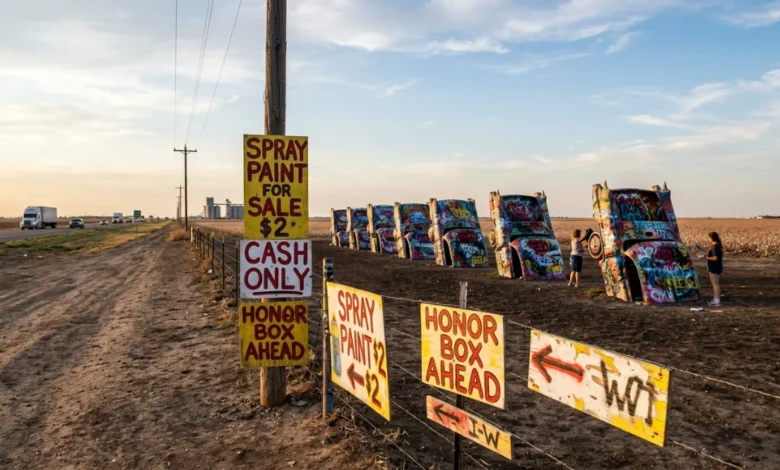
Drive west on Interstate 40 out of Amarillo, past the grain elevators and the flat-to-the-horizon cotton fields that make the Texas Panhandle feel like the edge of something rather than the middle, and somewhere around Exit 60 you’ll start seeing the signs. Not official green highway signs. Hand-painted plywood boards propped against fence posts, nailed to telephone poles, stuck in the dirt at jaunty angles, all pointing the same direction and all advertising more or less the same thing: spray paint for sale, two dollars a can, cash only, honor box if nobody’s home. Follow those arrows down a frontage road, pull into a dirt lot that never stops being dust no matter what time of year you visit, and there they are. Ten Cadillac sedans, buried nose-first into the Texas ground at an angle steep enough that the front halves disappear completely and the tailfins point skyward like the fins of some strange mechanical school of fish that swam here once and decided to stay.
They are painted in layers so thick that the original colors are long gone, buried under maybe ten thousand coats of Krylon and Rust-Oleum and whatever else people could find at the Amarillo Walmart before driving out here. On a still day, the smell of fresh paint hangs over the field like a chemical fog. On a windy day, which is most days in the Panhandle, the dust blows through the open windows and the stripped door frames, and the cars rattle slightly in their holes, as if they’re still trying to drive themselves out. Nobody stops here by accident. You have to want to find it, and millions of people do, every year, which raises a question that almost nobody asks once they’re standing in front of it: who buried ten perfectly good cars in a field on purpose, and why did the rest of America decide that was worth driving to see?
The Hippies and the Millionaire
The answer starts in San Francisco in 1968, with two architecture students who had no interest in building buildings. Chip Lord and Doug Michels met at Tulane University, moved to California, and founded something they called Ant Farm, a loose collective of artists and architects who wanted to make things that didn’t fit inside galleries or museums. They built inflatable structures. They staged media events. They made films. They were, by their own description, “car crazy,” obsessed with American automobiles not as machines but as cultural artifacts, symbols of freedom and consumption and the peculiar dream that the open road could somehow make you whole.
By 1973, Ant Farm had added a third member, Hudson Marquez, and the three of them were looking for a way to build something big, something permanent, something that would exist outside the art world’s usual circuits. They had an idea that had started as a joke and hardened into a concept: what if you buried cars in the ground like seeds, and they grew upward instead of down? Marquez had sketched seed packets labeled “’49 Ford” and “’59 Cadillac,” the kind of thing you might buy at a hardware store, only the plants would be full-sized automobiles. It was absurd, which was part of the point. But to make absurdity at that scale, they needed land, and they needed money, and they had neither.
So they did what desperate artists have done since forever: they wrote letters to rich people. Not just any rich people. Eccentric rich people, the kind who might answer a cold letter from three hippies in San Francisco proposing to bury cars in their yard. They mailed proposals to millionaires across the country. Most went unanswered. One did not.
Stanley Marsh 3 was not a typical Amarillo millionaire, if such a thing exists. He had inherited oil money and real estate holdings that made him one of the wealthiest men in the Panhandle, but he spent his time and his fortune on pranks, public art, and elaborate jokes played on a city he found, by most accounts, too dull for his tastes. He had already paid for a series of fake traffic signs planted around Amarillo, messages like “Road Does Not End” and “I Don’t Believe You,” and he had financed the “Dynamite Museum,” a scattered collection of mock gravestones and absurd monuments that still dot the city. When Marsh opened Ant Farm’s letter, he did not throw it away. He wrote back, and the letter was memorable enough that Marquez could still quote it decades later: oversized paper, 36-point type, the whole thing written in the voice of a man who understood that life was too short for small gestures. “I’d love to do something with you,” Marsh said, “but I only do things here in Amarillo.”
Lord and Michels drove to Texas. They stayed two days. By the end of the visit, Marsh had asked them to draft a proposal, and they had agreed. They went back to California and drew up a plan that was both simpler and more ambitious than their original seed-packet joke: a monument to the rise and fall of the Cadillac tailfin, ten cars representing the evolution of a single design feature that had defined American automotive excess from 1949 to 1963. The drawing included a budget. They would need $250 to hire a backhoe. They would need $300 for each of the ten cars. Marsh looked at the numbers and said yes.
What It Actually Took to Plant a Cadillac
The Ant Farmers arrived in Amarillo in June of 1974. They were three young men with long hair and strange ideas, camped on Stanley Marsh’s property, placing classified ads in the Amarillo Globe-News for used Cadillacs and driving around the Panhandle in an old pickup truck, trying to talk ranchers and mechanics into selling them cars that mostly didn’t run. Wyatt McSpadden, a young photographer who worked for Marsh at the time, remembered them as “mysterious, these three hippies,” gone for hours at a stretch and returning with stories about haggling over rusted hulks in somebody’s barn.
The first car they found, a 1949 Cadillac, cost $700, more than double their per-car budget. It was on the east side of Amarillo, and the seller knew they were desperate. McSpadden was there when they brought it back. “As soon as Doug had the title,” he later recalled, “somebody pulled the canvas off the bed of the truck, and it was full of sledgehammers and axes. Doug took an axe out and started beating on the front of the car. They didn’t care what the front of the car looked like. That was my first involvement with the Ant Farm and the Cadillacs.”
They had chosen a site on Marsh’s land near the intersection of Interstate 40 and the old Route 66, a flat stretch of dirt where the only thing taller than the grass was the occasional billboard. The backhoe arrived. They dug ten holes, each one deep enough to swallow the front half of a full-sized sedan, and then they started lowering the cars in. It was harder than they expected. They had never buried a car before. Nobody they knew had ever buried a car before. “We didn’t really know what we were doing,” Marquez said years later. “We hadn’t dug holes to put cars in before, and we didn’t know anyone who did, so we were just flying by the seat of our pants.” They settled on an angle of roughly 60 degrees, nose-down, tailfin-up, a slope that felt right without any mathematical justification. “We just dug some holes and drove the cars in at 60 degrees, same angle. We didn’t talk about that. It just happened to be. It looked good.”
The whole process took less than a week. Ten Cadillacs, one from each model year between 1949 and 1963, arranged in a straight line that followed the exact angle of the ancient Egyptian pyramids, though whether that alignment was intentional or accidental depends on which member of Ant Farm you ask and which year you ask them. The 1949 model, the one that cost too much, went in first. The 1963, the last year Cadillac made tailfins, went in last. When they were done, the cars stood in the field like a strange crop, chrome bumpers catching the Panhandle sun, windshields angled toward the dirt, steering wheels facing the sky.
Marquez woke before dawn the day after they finished. He drove to the site alone and watched the sunrise. “I was blown away,” he said later. He remembered a lecture by Marcel Duchamp, the French artist who had spent his career arguing that the viewer completes the work, that no creator ever reaches the full 100 percent of what they imagined. That morning, Marquez thought, he had come as close as he ever would.
On June 21, 1974, the summer solstice, Stanley Marsh threw a party. A big tent. An open bar. Amarillo notables in suits and cowboy hats, rubbing elbows with three artists who looked like they had gotten lost on the way to a rock concert. The Ant Farmers went back to San Francisco shortly after, leaving the cars behind in a field with no sign, no fence, and no explanation for what they were.
How the Rest of Texas Reacted
At first, almost nobody knew what to make of it. David Turner, then the assistant director at the Amarillo Art Center, remembered the local response as confused indifference. “When it was first built, it wasn’t hyped yet. People didn’t know what it was. It was just this oddball group of cars some crazy rancher planted in his field.” To see them up close required effort. There was no parking lot, no pathway, no official entrance. “You used to have to stop on the road, take your life in your own hands, go through a barbed wire fence, and hope for the best,” said Tom Livesay, another Amarillo art figure from that era. Most locals drove past without stopping. Some stopped and shot at the cars, because this was the Panhandle and that was what people did with strange things in fields.
The first damage came from bullets. The second came from keys, visitors scratching initials into the paint to prove they had been there. Lord and Marquez eventually drove out and signed the cars themselves, a preemptive copyright claim written in permanent marker on sheet metal. Then came the spray paint. A name here. A declaration of love there. A swear word. A phone number. At first, the graffiti was sporadic, the work of teenagers and drifters and bored locals. Tom Livesay asked Stanley Marsh what he thought of people defacing the artwork. Marsh’s answer became the official philosophy of the place: “I don’t give a damn. It showed ownership. People had to care enough about it, or hated it enough, to come see it. And they did.”
What changed everything was a television crew. In 1975, a year after the installation was finished, Charles Kuralt pulled his CBS News bus over on the shoulder of Route 66 and walked into the field with a camera. Kuralt was the country’s most famous chronicler of roadside oddities, a man whose entire career was built on finding exactly this kind of thing and presenting it to middle America with a warm chuckle and a raised eyebrow. He was charmed. “At first, we thought someone might be trying to raise little baby Cadillacs,” he told his audience. “Then we thought maybe the farmer just parked them this way each year after he bought a new model.” Marsh, interviewed for the segment, compared the installation to Stonehenge and declared it “the most important roadside attraction of our generation.” Kuralt ended the piece with a monologue that sounded like poetry written by a man who had spent too many hours on the interstate: “a cowboy herding steers out there where the tall tailfins grow and the traffic heads west on Route 66 and the Texas sun goes down on the chromium bumpers of the American dream.”
After that, the cars were famous. Not art-world famous. Roadside-famous, which is a different and in some ways more durable condition. People drove from other states to see them. They brought spray paint and left messages. They took photographs that ended up in photo albums and later on the internet. The cars became a pilgrimage site for a particular kind of traveler, the kind who measured a trip not by the destination but by the oddities found along the way.
The Move Nobody Expected
For twenty-three years, the Cadillacs stayed where the Ant Farmers had put them, in a field west of Amarillo, slowly accumulating paint and bullet holes and the kind of patina that only comes from being left outside in a climate that can produce 100-degree summers and ice storms in the same winter. But Amarillo was growing. The empty land around the original site was filling in with strip malls and housing developments and parking lots with floodlights that stayed on all night, bleaching the sky behind the cars into an ugly orange glow. By the mid-1990s, Stanley Marsh’s heirs were looking at a piece of property that had become too valuable to leave to art.
In 1997, the Cadillacs were dug up and moved two miles west, to a new field that was otherwise identical to the old one: flat, empty, visible from the interstate, surrounded by nothing but dirt and sky. The move was harder than the original installation. The cars had settled into their holes. The paint had welded them to the earth in a way that rust and time and gravity had made semi-permanent. But they came out, eventually, and they went back in, at the same angle, in the same order, facing the same direction. Wyatt McSpadden, who photographed both the original installation and the move, noted that from the road, nothing looked different. “It was harder digging them up and replanting them than it was putting them in the ground the first time. From the road, it didn’t change at all. It was still the same flatland background.”
The relocation coincided with the early internet, and Cadillac Ranch found a second life online. RoadsideAmerica.com featured it. Travel bloggers wrote about it. Social media turned it into a backdrop, a required stop on any Route 66 road trip, a place to take a photograph that would prove you had been somewhere. The meaning of the installation shifted, as the meaning of almost everything does when enough people look at it for long enough. What had started as a commentary on automotive design and American consumerism became something else: a participatory artwork, a public canvas, a place where the audience finished the piece in real time, every day, with spray paint.
What Happens There Now
If you visit Cadillac Ranch today, what you notice first is the smell. The scent of aerosol paint is constant, a chemical undertone to the dust and the heat and the faint odor of cow manure that drifts over from the surrounding ranchland. The cars are no longer recognizable as individual vehicles. They are shapes, ten elongated bumps of color rising from the earth, each one coated in layers of paint so thick that the door handles are buried, the windows are opaque, and the tailfins have become soft, rounded nubs where sharp chrome used to be. People do not just paint the cars. They paint the dirt around the cars. They paint the access road. They paint the wooden barriers that were installed, eventually, to keep people from driving directly into the field. They paint the trash cans. They paint each other, sometimes by accident, sometimes on purpose.
The paint does not last. A fresh coat can survive twenty minutes on a busy Saturday before somebody else covers it. The layers underneath are not lost; they are simply buried, archaeology in reverse, a history of American graffiti compressed into the metal skin of ten automobiles. On Cinco de Mayo, the cars turn red, white, and green. After the death of Doug Michels in 2003, Ant Farm painted them black. For breast cancer awareness, they have been pink. For no reason at all, they have been every color that Krylon manufactures, and some that it does not.
Wyatt McSpadden spent two days at the site in 2022, making portraits of visitors for an exhibition at the Amarillo Museum of Art. “I got people from England, Switzerland, Italy, the Netherlands, Germany, Ireland,” he said. “People paint, they leave, and 20 minutes later somebody comes up and paints over what they painted.” The cars are seen by an estimated 1.4 million people every year, which makes them the most visited artwork in Texas and one of the most visited in the country, though almost nobody who stands in front of them thinks of them as art in the traditional sense. They are a destination. A photo op. A place to leave your mark, however briefly, on something that will outlast you.
Four years ago, Stanley Marsh’s son, Stan Marsh 4, added a merchandise truck to the dirt lot. It sells spray paint, bottled water, and souvenirs. “The Cadillacs are one of the last things in the nation that are truly wild,” he told a reporter. “There are no bathrooms. There is no running water. There’s no shade. There’s a different energy out there. It’s an adventure every time.” He was not wrong. On a July afternoon, the heat radiating off the metal is intense enough to make the air shimmer. On a January morning, the wind cuts through the open frames of the cars with a sound like someone blowing across the top of a bottle. There is no shelter. There is no explanation posted anywhere, no plaque, no museum text, no guard to tell you what you are looking at. Just ten cars in the dirt, and the understanding that you are expected to add to them, not simply observe.
The Man Who Paid for It, and the Question of Legacy
Stanley Marsh 3 died in 2014, after a series of strokes that left him unable to speak or defend himself against allegations that had surfaced in his final years, accusations of sexual misconduct with minors that complicated his legacy in ways that the art world and the city of Amarillo are still navigating. His family transferred ownership of the land to a trust before his death, and the Cadillac Ranch remains under their control, though the trust’s exact plans for the site have never been made public in detail. Marsh’s reputation has become bifurcated: the prankster patron who funded one of America’s most beloved roadside attractions, and the aging millionaire accused of crimes that make his name difficult to celebrate without qualification.
The artists, too, have had complicated afterlives. Doug Michels died in 2003, hit by a car while walking in Australia, a death so sudden and strange that it felt, to those who knew him, like the kind of cosmic joke he would have appreciated. Chip Lord became a professor at the University of California, Santa Cruz, and continued to make work, though nothing he did afterward ever matched the sheer visibility of the cars in the field. Hudson Marquez moved to Europe and spent years trying to explain to people in Barcelona and Berlin why ten buried automobiles in Texas mattered to American culture. He eventually settled on a simple formulation: “One was the Cadillac Ranch. The other was copyrighting Cadillac Ranch. Ant Farm owns the copyright to Cadillac Ranch. For many years we’ve made money, it’s like an annuity. Commercials, clothing lines, billboards, print ads, everything.”
He was not complaining. The irony of a radical art collective funded by oil money, creating a critique of consumerism that became a consumer destination, licensing its image for advertisements that sold the very things the installation was supposed to question, was not lost on any of them. But irony, like the paint on the cars, is just another layer. You can stand in front of Cadillac Ranch and feel whatever you want to feel about America, about automobiles, about the open road, about the passage of time. The cars do not argue back. They simply stand there, nose-down in the dirt, tailfins pointing at a sky that goes on forever, waiting for the next person with a two-dollar can of spray paint and something to say.
Why They Still Matter
The most honest answer to why ten Cadillacs stand buried in Texas dirt is that nobody ever decided they should not. There was no moment when the city of Amarillo voted to remove them, no preservation society that fought to keep them, no government grant that ensured their survival. They exist because Stanley Marsh wanted them to, because the Ant Farm built them sturdy enough to survive the weather, and because enough people kept coming that tearing them down would have felt like an act of cultural vandalism even to those who never liked them in the first place.
They are not beautiful, at least not in any conventional sense. They are not profound, unless you bring your own profundity to them. They are ten old cars in a field, painted over so many times that the original metal is probably thinner than the accumulated layers of pigment covering it. But they are also something rarer: a piece of American landscape that refuses to be finished. Every visitor who sprays a name or a date or a crude drawing onto those tailfins is participating in the work, adding to it, changing it, ensuring that the Cadillac Ranch of today is not the Cadillac Ranch of yesterday and will not be the Cadillac Ranch of tomorrow.
That is, in the end, what makes them worth pulling off the interstate for. Not the history, though the history is strange enough to be worth knowing. Not the art-world credentials, though the art world has spent fifty years trying to decide whether they belong in a museum or a demolition yard. What makes them matter is the simple fact that they are still there, still changing, still accumulating meaning like sediment, ten metal monuments to the idea that America’s strangest and most durable culture is not the one made by professionals in New York or Los Angeles but by three kids with a backhoe, a rich man with a sense of humor, and the millions of ordinary people who drove past, stopped, and decided to leave their mark.
Drive west on Interstate 40. Take the frontage road. Follow the hand-painted signs. The field is still flat. The sky is still wide. And the cars are still there, waiting in the dirt, half-buried and fully alive, fins to the wind, paint wet and drying in the Texas sun.