

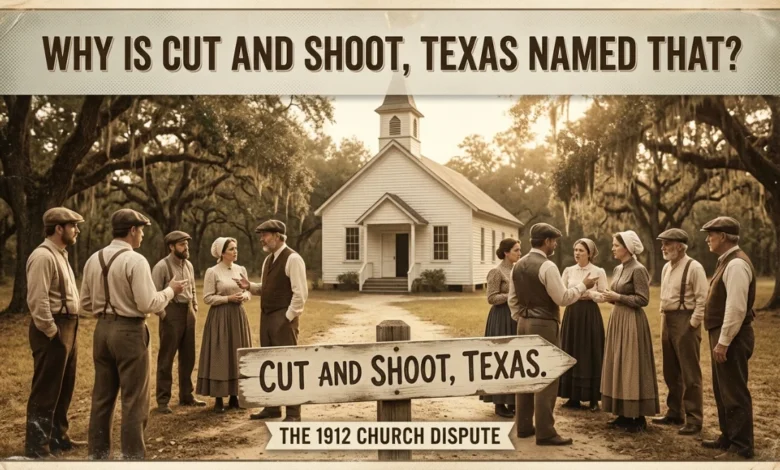
The families came by wagon and buggy, and most of them brought lunch. That detail is the strangest part of the whole story. On a July morning in 1912, in a patch of pine woods in eastern Montgomery County, Texas, two sides of a church dispute rode toward the same small building with guns hidden under wagon seats and inside coat pockets, and they packed a picnic anyway, because whatever was about to happen, it was still going to be a long day and everyone would still need to eat.
The building was called the Community House. It sat somewhere in a stretch of unincorporated land about six miles east of what is now Conroe and forty miles north of Houston, in a settlement so small and so new that, according to the accounts collected decades later, it did not yet have a name of its own. By the time the sun went down on that Sunday, it did. Cut and Shoot, Texas, exists on maps today because of an argument over who was allowed to preach in a one-room church, and more than a century later, nobody can say with total confidence exactly what the argument was actually about.
A Community Without a Name
Before 1912, the settlers in this part of Montgomery County did what a lot of small rural communities did: they pooled their labor and their lumber and built one building to serve as both church and school. Three congregations shared it, the Missionary Baptists, the Hard-Shell Baptists, and the Methodists, and by most local accounts they had worked out an arrangement ahead of time about who could use the space. According to a history compiled by the town itself, the founding agreement allowed every denomination to preach there except two: the Mormons and the Apostolics.
That carve-out mattered, because Texas in the 1910s was in the middle of a religious shift that a lot of established rural congregations found unsettling. The Pentecostal and Apostolic movements were spreading fast through the South, often through traveling evangelists who showed up in a community, held revival meetings in whatever building was available, and left behind converts and controversy in roughly equal measure. The people who built the Community House had apparently already decided they wanted no part of that. What they had not planned for was what would happen when someone invited an Apostolic preacher anyway.
The Preacher Nobody Could Agree On
In July 1912, a traveling evangelist identified in the town’s own historical account as a Preacher Stamps arrived in the area, and a faction of the congregation invited him to hold a meeting at the Community House. According to that same account, Stamps did not have the cleanest reputation among the community’s more conservative members, who claimed he had been known to visit saloons and go dancing, activities that would have scandalized a rural Baptist congregation of that era regardless of what he preached on Sunday.
Other tellings of the story leave Stamps out entirely. The Texas State Historical Association’s version says the dispute was over one of three possible things: the design of a new steeple for the church, the question of who should be allowed to preach there at all, or a disagreement over land claims among church members. That’s the honest state of the record. Multiple versions exist, they don’t agree with each other on the specifics, and no single account has ever been established as definitive. What all of them agree on is the outcome: a preaching dispute turned into an armed standoff, and the standoff turned into a town name.
The Night the Doors Got Locked
The version built around Preacher Stamps gives the clearest timeline, so it’s the one worth following in detail, while keeping in mind that other explanations for the underlying dispute exist. On July 20, 1912, the day before Stamps was scheduled to preach, a son from one of the families opposed to the meeting was sent to get the keys from one of the school trustees so the Community House could be locked. Word of this got back to the families who supported the meeting, and they answered in kind: they let it be known that if the doors were locked, they’d break them down.
From there, things escalated fast and in both directions at once. A member of the group opposing the meeting saddled up and rode through the community that night telling people to bring their guns to the Community House the next morning. Word of that ride reached the other faction just as quickly, and one of their members did the same thing, riding out to make sure his side showed up equally prepared. By the next morning, both factions were headed to the same building, armed, each convinced the other side meant to start something.
Guns, Wagons, and Sunday Dinner
July 21, 1912 fell on a Sunday, [VERIFY: confirm July 21, 1912 was in fact a Sunday]. Families arrived by wagon and buggy through the morning, and by most accounts they came expecting to stay all day, since a preaching service in a farming community back then was usually followed by dinner on the grounds and an afternoon of visiting. That expectation didn’t change even with weapons in reach. People set up for what was supposed to be a full day of fellowship while both sides waited to see whether the other would actually try to force its way in.
What happened next is the part where the historical record goes soft. No source claims anyone was shot, and no casualty figures show up in any of the accounts pulled together for this story, which suggests the standoff cooled before it turned into actual gunfire. But none of the surviving sources spell out exactly how the day ended, who backed down first, or whether the disputed sermon was ever delivered. [VERIFY: whether the Apostolic preaching service took place as scheduled, and how the standoff was defused]. What survived instead was a phrase.
Whose Words Actually Named the Town
Here the story splits again, and this time the disagreement is about who said the words that became the town’s name.
One version, drawn from research at the Texas Center for Regional Studies, centers on a man named Archie Vick, a witness to the confrontation. Sometime after that Sunday, when Vick was asked where the whole incident had taken place, he reportedly answered that it happened at “where they had the cutting and shooting scrape.” Shortened over time, that became “Cut’n Shoot,” and the name stuck.
A separate and more widely repeated version, the one recorded by the Texas State Historical Association and passed down through most popular retellings, credits a small boy who was present at the standoff. Frightened by the tension building around him, the boy is said to have blurted out, “I’m going to cut around the corner and shoot through the bushes in a minute!” That line, half warning and half nervous bravado from a kid caught in the middle of an adult standoff, is the version most commonly printed in newspapers and travel writeups today.
Both stories can’t be the literal origin of the same three words, and no primary document settles which one is accurate, or whether the truth is some blend of the two that got flattened into a cleaner story with each retelling. The most detailed written account of the day traces back to a 1952 master’s thesis by William Harley Gandy, a University of Houston graduate student whose own family had been involved in the original incident. That’s a useful record, but it’s also a source with a personal stake in how the story got told, which is worth keeping in mind whenever a single family’s version becomes the “official” history of a whole town.
A Name That Took Decades to Become Official
Whichever version is closer to true, “Cut and Shoot” or “Cut’n Shoot” spent the next several decades as an informal name for an unincorporated community, the kind of place-name locals use and outsiders mostly never hear. There was no post office, no town charter, and for a long stretch of the early twentieth century, not much reason for the rest of Texas to know the name existed at all.
That changed because of one man from that same small community: a boxer named Roy Harris.
The Fighter Who Put Cut and Shoot on the Map
Roy Harris grew up in Cut and Shoot and turned into a legitimate heavyweight contender, good enough that in 1958 he got a shot at the world heavyweight title against champion Floyd Patterson. Harris lost the fight, but the exposure that came with it changed the town’s fortunes overnight. He landed on the cover of Sports Illustrated and was featured in LIFE magazine, and both publications made a point of noting where he was from, because “Cut and Shoot, Texas” was simply too good a detail to leave out of a boxing profile.
Fan mail poured in addressed to “Roy Harris, Cut and Shoot, Texas,” in volumes heavy enough that the U.S. Postal Service granted the town a contract post office. According to the Texas Center for Regional Studies, that post office opened on August 18, 1958, timed deliberately to coincide with the Harris-Patterson fight, [VERIFY: exact date and intentional timing of the 1958 post office opening]. For a community that had spent forty-some years as an unofficial name on nobody’s map, a functioning post office was the first real piece of government recognition it had ever received.
Harris’s career didn’t end at the ropes. After retiring from boxing, he became a lawyer and went on to serve for years as the Montgomery County clerk. In that role, he was the one who helped push through the paperwork that finally made Cut and Shoot an official town.
From Community to Town to City
On April 5, 1969, residents held an election to incorporate the Town of Cut and Shoot. Town officials, including a mayor, five councilmen, and a town marshal, were elected the following month, on May 17, 1969. At the time of incorporation, the town’s population stood at roughly 200 people.
Growth after that was slow and steady rather than dramatic. By 1980, the population had climbed to 809, and the town had built a new town hall and gained a school and a handful of businesses. Stephen F. Austin Elementary, part of the Conroe Independent School District, still sits within the town today. Population kept climbing through the following decades, reaching 903 in 1990 and eventually 1,087 at the 2020 census. In 2006, the town council voted to change Cut and Shoot’s official designation from “town” to “city,” a largely administrative shift that nonetheless made news mostly because of how funny the resulting phrase sounded: the City of Cut and Shoot.
What Remains Today
Cut and Shoot today covers about 2.7 square miles of land in eastern Montgomery County, close enough to the Houston metro area to draw commuters but still rural enough to feel like its own place. Nearby, the old Cut and Shoot airstrip has been redeveloped in recent years into an aviation training hub, [VERIFY: current name and operational status of the redeveloped airfield], part of a broader wave of small development around Conroe. The Community House itself is long gone, and no marker, plaque, or ruin at a fixed, verifiable location survives to mark exactly where the 1912 standoff happened, [VERIFY: whether any physical site marker or plaque exists at the historic Community House location].
What does survive is the name, and the argument about where it came from. Local historians still cite Gandy’s 1952 thesis and Robin Montgomery’s 1984 book, “Cut’n Shoot, Texas: The Roy Harris Story,” as the fullest written accounts, but both rely heavily on family memory passed down through a single, closely connected community rather than court records, newspaper coverage from 1912, or any other outside documentation. That’s not unusual for small-town origin stories. Most of them are held together by exactly this kind of oral history, repeated at church suppers and family reunions until the details harden into fact. It just means the honest answer to “why is Cut and Shoot called that” is not a single clean sentence. It’s a Sunday morning that nearly went wrong, a phrase that outlived the argument that produced it, and a hundred years of Texans telling the story slightly differently every time, and still agreeing on the only part that actually matters: whatever happened that day, nobody got shot, and the name stuck anyway.
