What Really Happened the Night the Sodder Children Vanished
What Really Happened to the Sodder Children?

George Sodder ran around the side of his burning house looking for the ladder he kept propped against the wall every single night of the year. It wasn’t there. He turned instead toward his two coal trucks, parked exactly where he’d left them hours earlier after a full day’s work, thinking he could climb onto one and reach the second-floor windows where he believed five of his children were trapped. Neither truck would start, though both had run perfectly that same afternoon. He tried a rain barrel next, hoping for enough water to slow the flames near a window. It had frozen solid overnight. By the time anyone reached the Fayetteville Fire Department, the fire had already taken the house down to its foundation, and five of George and Jennie Sodder’s ten children, Maurice, Martha, Louis, Jennie, and Betty, were gone. Their bodies were never found. Not that Christmas, not in the months that followed, not ever.
A Family Built From Two Immigrations
To understand what happened in Fayetteville, West Virginia, in the early hours of December 25, 1945, it helps to understand who George and Jennie Sodder were before that night. Both had been born in Italy and had come to the United States as children, George arriving around age 13 and Jennie as a toddler. They met in the coal country of southern West Virginia, where Jennie’s father ran a store in the nearby town of Smithers and George passed through regularly on his trucking route. They married, settled in Fayetteville, and built a life around George’s small coal-hauling business, eventually raising ten children in a two-story frame house a few miles outside the town center.
Fayetteville in the 1940s had a sizable Italian immigrant community, and like a lot of Italian-American communities during the Second World War, it was not united in its opinions about the old country’s government. Benito Mussolini’s fascist regime had genuine supporters among Italian immigrants in towns like Fayetteville, and genuine opponents too, with little room in between for people who simply didn’t care. George Sodder cared, and he was not quiet about it. By multiple family accounts, he argued openly and often against Mussolini and fascism, the kind of talk that could make a man unpopular in exactly the wrong rooms.
That mattered later, because in the months before the fire, several strange incidents unsettled the family enough that they remembered them clearly for the rest of their lives. In October 1945, a traveling life insurance salesman came to the house and was turned away by George. According to family accounts, the man grew angry and warned George that his house would burn and his children would be destroyed, tying the threat explicitly to George’s public remarks about Mussolini. Around the same period, a man who came by looking for hauling work wandered to the rear of the house, pointed at the two fuse boxes there, and remarked that it looked like the kind of setup that would cause a fire one day, a comment George found odd since the local power company had checked the wiring and pronounced it sound not long before. In the weeks leading up to Christmas, the family also noticed an unfamiliar car parked near the road on more than one occasion, its occupants apparently watching the younger Sodder children as they walked home from school. None of these episodes proved anything on their own. Together, they were the kind of details a grieving family would return to again and again once the fire made them impossible to dismiss as coincidence.
Christmas Eve
On the night of December 24, 1945, George, Jennie, and nine of their ten children gathered at the house for Christmas Eve. The oldest son, Joe, [VERIFY: correct name and status of the eldest Sodder son who was away from the house that night, as some accounts give a different name for him], was serving in the military and away from home. The younger children stayed up later than usual playing with new toys, and by the time everyone finally went to bed, it was already deep into the night.
Sometime around midnight, the telephone rang and woke Jennie. When she answered, instead of a familiar voice, she heard laughter and a question about a name she didn’t recognize, as though the caller had dialed wrong, or wanted her to think so. She went back to bed. Not long after, she heard what she described as a thud on the roof, followed by the smell of smoke. By roughly 1 a.m., the fire had taken hold.
George, Jennie, and four of the children, 23-year-old John, 17-year-old Marion, 16-year-old George Jr., and 2-year-old Sylvia, made it out. The other five, 14-year-old Maurice, 12-year-old Martha, 10-year-old Louis, [VERIFY: Louis Sodder’s exact age at the time of the fire, since sources are inconsistent, giving either 9 or 10], 8-year-old Jennie, and 5-year-old Betty, were believed to still be upstairs, in two bedrooms separated by a staircase that was already engulfed in flame. That was when George went looking for his ladder and found it missing, then for his trucks and found them dead, then for water from the barrel and found it frozen. Marion ran to a neighbor’s house to call the fire department. The call didn’t go through. A neighbor flagged down a passing motorist, who tried again from a nearby tavern, with no better luck. Eventually someone reached Fire Chief F.J. Morris directly, who reportedly said the department was short on manpower because of the holiday. By most accounts, it took several hours for firefighters to reach the scene, [VERIFY: the precise elapsed time between the start of the fire and the fire department’s arrival, commonly cited as around seven hours but not consistently sourced], and by then there was nothing left to save. The house had burned to the ground in well under an hour, leaving behind a foundation, some scorched household appliances, and no visible remains of the five missing children.
An Accident, Officially
The investigation that followed did not last long. A coroner’s inquest ruled the fire accidental, attributing it to faulty wiring, a conclusion George disputed from the start, since he’d had the wiring inspected himself not long before and had been told it was fine. On December 30, 1945, the state issued death certificates for all five missing children, despite the fact that no bodies, bones, or other physical remains had been recovered from the site. For George and Jennie, that absence became the center of everything that followed.
The Sodders’ doubts sharpened when they looked into how fire actually affects human bone. A local crematorium employee told Jennie that bodies didn’t fully disintegrate even at temperatures far higher and for far longer than what the Sodder house fire had likely produced, since crematoriums typically burned remains for a couple of hours at around 2,000 degrees Fahrenheit to leave only bone fragments behind, not ash. The Sodder fire, by comparison, had consumed the house in something like 45 minutes. There was also no report of the smell typically associated with burning flesh, and the household appliances recovered from the site were still identifiable rather than destroyed, which made it harder to believe the blaze had been hot enough to erase five children’s skeletons entirely.
Then there was Fire Chief Morris himself. According to accounts from people close to the family, Morris told a local minister sometime after the fire that he had in fact found something resembling a heart in the ashes, which he’d quietly buried rather than tell the Sodders about it directly. When the item was later examined, it turned out to be a raw beef liver that showed no sign of ever having been exposed to fire. Morris reportedly admitted he’d placed it there himself, hoping to give the grieving family some sense of physical closure rather than leave them with nothing at all. Whatever his intentions, the episode did the opposite of settle anything. It became, for the Sodders, one more reason to distrust the official account of what had happened to their children.
Digging Again
The family did not let the matter rest with the 1945 ruling. In August 1949, nearly four years after the fire, George and Jennie brought in a Washington, D.C. pathologist, Oscar B. Hunter, to excavate the site themselves, since Chief Morris had never conducted anything close to a thorough search of the ashes at the time. Hunter’s search turned up a handful of small items, along with several shard-like fragments of what appeared to be vertebrae. He sent them to the Smithsonian Institution for analysis. The Smithsonian’s report concluded that the fragments belonged to a single individual, and that based on the degree of skeletal fusion present, that person had most likely been between sixteen and seventeen years old at time of death, with an outer age limit of around twenty-two, since the relevant bone structures typically fuse by that age. The oldest of the five missing Sodder children, Maurice, was fourteen. None of the fragments could plausibly have come from any of the missing children based on that age range, and the Smithsonian’s own report speculated the bones might simply have come from dirt brought in from elsewhere, [VERIFY: exact wording and full findings of the Smithsonian Institution’s 1949 report on the recovered bone fragments], since the family had used soil to fill in the old basement years earlier while turning the site into a memorial garden.
That finding, instead of closing the case, reopened the argument in the opposite direction. If the remains found on the property weren’t the Sodder children, where were they? The state of West Virginia held hearings on the matter at the Capitol in Charleston, and Governor Okey L. Patterson ultimately declared the investigation officially closed in 1950, without offering a revised account of what had happened to the five children beyond the original ruling of accidental fire death.
Letters, a Billboard, and a Photograph
George and Jennie refused to accept that conclusion. They hired at least one private investigator, C.C. Tinsley of the nearby town of Gauley Bridge, to look into the case independently. They also wrote to the FBI. Director J. Edgar Hoover responded personally in 1947, explaining that the matter fell outside federal jurisdiction as a local case, though he noted that agents would assist if local authorities requested it. Fayetteville’s police and fire departments declined to make that request. Around 1950, the FBI did open a file examining the possibility of an interstate kidnapping, but closed it again after roughly two years without developing any solid leads, [VERIFY: exact dates and outcome details of the FBI’s 1950 interstate kidnapping inquiry into the Sodder case].
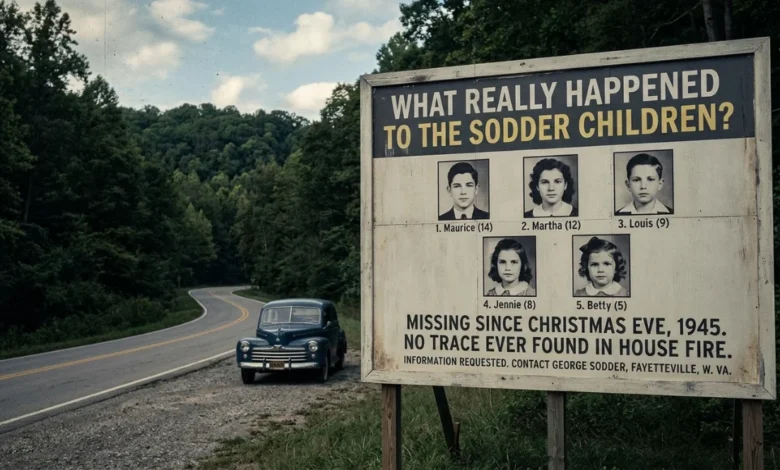
In the early 1950s, the family erected a billboard along State Route 16 near Fayetteville, showing photographs of all five missing children along with a description of the case and an offer of reward money for information leading to answers. It stood there for close to four decades, a fixture of the highway that locals and travelers passed for years, until it finally came down shortly after Jennie Sodder’s death in 1989.
The most tantalizing piece of evidence arrived by mail sometime in the late 1960s, [VERIFY: the precise year Jennie received the photograph, since sources variously date it to 1965, 1967, or 1968], postmarked from Central City, Kentucky, with no return address. Inside was a photograph of a young man who appeared to be in his late twenties or early thirties, along with a handwritten note on the back that read, in a phrasing repeated across multiple retellings of the case, something to the effect of “Louis Sodder, I love my brother Frankie.” George and Jennie believed the man in the photo closely resembled how their son Louis might have looked as an adult. They hired an investigator to travel to Central City and track down whoever had sent it. That investigator took his fee, went to Kentucky, and was never heard from again, [VERIFY: identity and further details of this investigator, since accounts of what happened to him are secondhand and largely undocumented]. The photograph itself survived and was added to the family’s billboard, but no one was ever able to trace it back to a real, confirmed identity.
What Never Got Resolved
George Sodder died in 1969, having spent much of the two decades after the fire following leads, real and rumored, across the country. Jennie continued the search and continued tending the memorial garden the family had built over the old basement, until her own death in 1989, after which the Route 16 billboard finally came down. Of the four children who survived the fire, John died in 2001, Marion in 2005, George Jr. in 2012, and Sylvia, the youngest survivor and the last of the four still living, in April 2021, having spent her whole life believing, as her parents had, that her siblings had not died in that fire.
No one has ever produced a body, a confession, or a documented sighting that conclusively resolves what happened to Maurice, Martha, Louis, Jennie, and Betty Sodder. The official record still lists an accidental fire as the cause of death for five children whose remains were never recovered. The family’s competing theory, that the fire had been set deliberately, possibly by men connected to organized crime or to wartime tensions within Fayetteville’s own Italian-American community, and that the children had been taken rather than killed, was never proven either. What’s left is a set of facts that don’t fully agree with each other: a missing ladder, two trucks that wouldn’t start, a phone line later found to have been cut rather than burned through, a coroner’s ruling that preceded any real search of the ashes, and, years later, human bone fragments that quite clearly belonged to someone far too old to have been any of the missing children.
Fayetteville still tells this story every Christmas, less as a solved case with a moral than as an open wound the town has learned to live around. The Sodder memorial garden remains where the house once stood, a quiet patch of ground for a family that never stopped waiting for an answer that never came. Whatever happened to those five children on Christmas Eve in 1945, the honest version of the story is the one that admits, plainly, that nobody alive today actually knows.