Belmont, Nevada: The Ghost Town That Never Fully Died
A Courthouse With No County Left to Serve

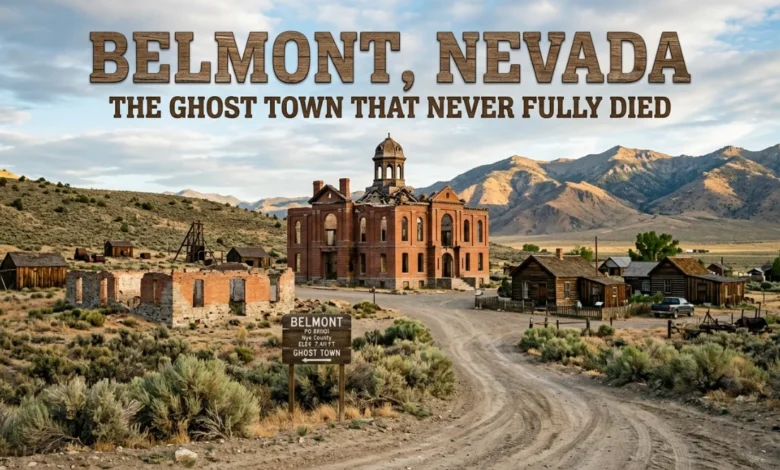
The brick tower of the old Nye County Courthouse is visible from a long way off, rising over a scatter of stone ruins and sagebrush in a high valley of the Toquima Range in central Nevada. There’s no traffic light out here, no gas station, not even a paved road most of the way in. What there is, improbably, is a person still living in the house next to the old Cosmopolitan Saloon, and a handful of restored buildings standing where a boomtown of several thousand people once did business. Belmont, Nevada was never fully abandoned. That’s the detail almost every other Nevada ghost town can’t claim, and it’s also the reason its story doesn’t end cleanly on any single date, no matter how tempting it is to pick one.
Silver in the Toquima Range
The story begins in 1865, when prospectors found silver ore in a stretch of the Toquima Range that would come to be called the Philadelphia district, also known locally as the Silver Bend district. Some accounts credit the initial discovery to Native American prospectors working the area before word reached the mining camps at Austin and Ione, Nevada, both established a few years earlier during Nevada’s first wave of silver strikes. Whatever the exact sequence, the ore that turned up was rich enough to matter: surface rock assaying as high as $3,000 a ton by weight, [VERIFY: exact assay figures and their sourcing for the initial 1865-1866 strikes], which by 1866 had triggered a genuine rush, pulling miners away from Austin and other established camps and toward this new, unnamed stretch of desert.
The camp that grew up around the strike took the name Belmont, and it grew fast enough that within a year it was competing for something more than just claims and stamp mills. In February 1867, Belmont was named the county seat of Nye County, displacing the earlier seat at Ione. For a mining camp barely two years old, that was a significant vote of confidence, and it set Belmont on a different course than most Nevada boomtowns, which rose and fell purely on the strength of ore in the ground. Belmont now had government offices, county records, and a reason to build for permanence rather than just for the length of a mining season.
A Town Built to Last, In a State That Rarely Allowed It
Most Nevada mining camps of the era were thrown together out of whatever was cheapest and fastest, canvas, scrap lumber, and salvaged tin, because nobody expected the ore to hold out long enough to justify anything sturdier. Belmont had an unusual advantage: nearby access to timber, water, stone, and clay, all in a part of the state where at least one of those was normally missing. That allowed the town to put up real brick and stone buildings instead of the shanty construction typical of a Nevada boomtown, and Belmont used that advantage aggressively.
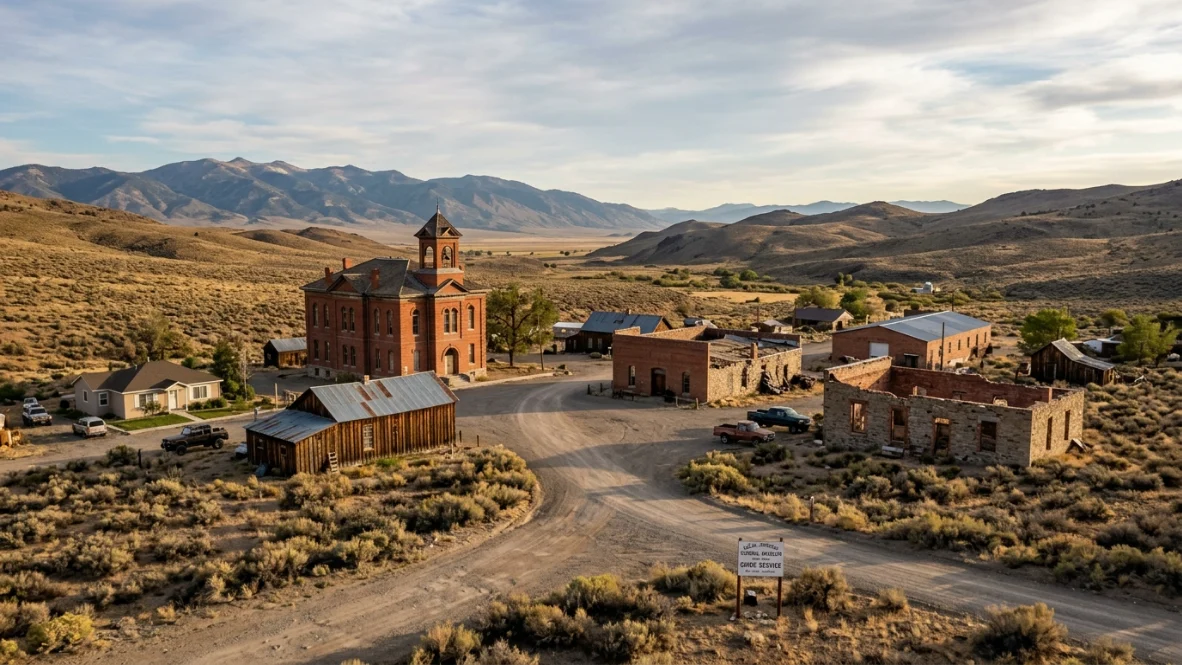
By the early 1870s, the town had two competing newspapers, the Silver Bend Reporter and the Mountain Champion, along with a bank, a school, a telegraph office, an assay office, stores, saloons, restaurants, a livery stable, and a post office that had opened its doors back in April 1867. Its centerpiece for entertainment was the Cosmopolitan Saloon and its attached music hall, which by multiple later accounts drew traveling performers from well outside the immediate mining district, an unusual amenity for a town this deep in the Nevada interior. Just how many people actually lived in Belmont at its peak, though, is one of the places where the historical record simply doesn’t agree with itself.
A Population Nobody Can Pin Down
Estimates of Belmont’s peak population, generally placed somewhere in the boom years of the late 1860s and early 1870s, range from as low as 2,000 to as high as 15,000, depending on which source is doing the counting. The higher figure appears to be more legend than fact: Nye County as a whole didn’t reach a population of 9,000 people until 1980, which makes a single-town figure of 15,000 more than a century earlier essentially implausible on its face. Other sources land on figures closer to 4,000, or roughly 10,000 at the absolute peak of the boom, [VERIFY: most credible peak population figure for Belmont, and the specific years it applies to]. What can be said with more confidence is that Belmont was, for a few years, one of the larger and more consequential towns in central Nevada, regardless of exactly which number belongs on the historical marker.
Sometime in that same window, likely 1868, [VERIFY: exact construction year of the original Nye County Courthouse building, since sources place it in either 1868 or 1876] Belmont’s growing county government needed a permanent home, and a brick courthouse went up to house it. Some later sources tie the courthouse’s construction to a second wave of investment in the mid-1870s, after a lull in the district’s fortunes, rather than to the original 1860s boom. Either way, that courthouse building would go on to outlast almost everything else the town built around it, and it remains, along with the Cosmopolitan Saloon and the ruins of the Monitor-Belmont and Combination mills, one of the handful of Belmont structures still standing today.
The First Ending: When the Silver Ran Thin
Belmont’s fortunes tracked the ore, as they did in every mining town of this kind, and the ore did not last. The bulk of the district’s total production, estimated afterward at around $15 million worth of silver, copper, lead, and antimony combined, came out of the ground between 1866 and 1887. After that, the richest and most accessible deposits had largely played out, and by the late 1880s most of the district’s mines had shut down. Belmont did not disappear overnight the way some Nevada camps did. It held on as a functioning, if steadily shrinking, town through the 1890s, with tailings from earlier operations reworked by smaller outfits looking for whatever silver the original miners had left behind. But by 1900, only a handful of businesses remained open, a fraction of what the town had supported thirty years earlier.
The final institutional blow came in 1905, when the Nye County seat was formally relocated from Belmont to Tonopah, a newer boomtown built on a fresh silver strike that had, in the space of a few years, eclipsed Belmont in both population and importance. By most accounts, there was little organized resistance to the move. Belmont’s decline was already obvious to everyone living through it, and losing the county seat mostly confirmed what the town’s own shrinking business district had already been saying for years.
A Second Wind, and a Second Ending
Belmont’s post office closed in May 1911, which might have marked the practical end of the story if the town’s history moved in a straight line. It didn’t. World War I brought a fresh, if modest, round of mining activity back to the district, driven by wartime demand for industrial metals, and the activity was enough to justify reopening the Belmont post office in September 1915. A new mill, the Highbridge, went up during this period to process ore from the renewed operations, [VERIFY: specific ore type and scale of production processed by the Highbridge mill during its World War I-era operation].
That second act didn’t last either. The Belmont post office closed for good in 1922, and with wartime demand gone and the district’s remaining ore increasingly marginal to extract, that closure functions as the closest thing Belmont has to an official end date, the year the federal government stopped treating it as a place worth serving with regular mail. It’s a fittingly bureaucratic bookend for a town whose life had already been defined by two previous endings, in 1887 and again in 1905, each one just as real as the one that finally stuck.
The Town That Refused to Finish Dying
Here is where Belmont breaks from the pattern of most Nevada ghost towns, including some of the state’s more famous ones. Places like Rhyolite, roughly abandoned within a decade of its founding, or Berlin, preserved today only because it was left completely untouched, tend to have one clean moment of total abandonment: the last resident leaves, and the town becomes a ruin. Belmont never had that moment. A small population held on through the post office’s second closure and kept holding on for decades afterward, which is the reason Belmont’s buildings survived in usable condition rather than being stripped for scrap or left to collapse entirely, the fate that met so many of its contemporaries.
Much of the credit for that survival, according to local histories and a historical marker placed in the area, goes to a woman remembered as the “Belmont Guardian,” a resident named Rose Walter [VERIFY: correct spelling of this resident’s name, as at least one source transcribes it differently], who along with a Native American woman named Sarah remained among the last residents of Belmont after Rose’s husband died in 1953. Sarah passed away a few years afterward, leaving Rose as the town’s only permanent resident for close to three decades. She reportedly carried a .44 caliber pistol, used as much on rattlesnakes as on the occasional scavenger looking to strip copper wiring or hardware from the empty buildings, and her presence is generally credited with keeping Belmont from being picked apart the way so many other remote Nevada camps eventually were. She was featured in a 1974 issue of National Geographic, [VERIFY: exact month and year of this National Geographic feature, and the specific details reported in it], and she died in 1987 at the reported age of 93, [VERIFY: exact birth and death years for this individual, given inconsistent transcriptions of the historical marker text].
Whether one woman with a pistol can really be credited with single-handedly preserving an entire ghost town is the kind of claim that’s hard to verify and easy to romanticize, and it’s worth holding it a little loosely. But the basic fact underneath the legend, that Belmont maintained at least some year-round population through the decades when most of its Nevada contemporaries were emptying out completely, is well documented and is very likely the single biggest reason its buildings are still standing today rather than existing only as foundations and a historical marker.
What’s Still Standing
Belmont was added to the National Register of Historic Places in 1972, and the site carries Nevada Historical Marker number 138 today. The old courthouse has undergone restoration work led by a preservation group known as the Friends of the Belmont Courthouse, and the building is now recognized as a Nevada state historic site rather than simply an abandoned county office. Alongside it, visitors can still find the Cosmopolitan Saloon, the ruins of the Monitor-Belmont Mill and the Combination Mill, and scattered stone and brick foundations from a Main Street that once supported thousands of people, or perhaps a few thousand, depending on which historical estimate you trust.
Belmont sits along what was once State Route 82, roughly 45 miles northeast of Tonopah, the town that took its county seat away in 1905 and has, in the century since, gone on to a much longer and more prominent life of its own. The two towns’ fortunes crossed paths once, in the early twentieth century, and then went in opposite directions, Tonopah growing into a real city while Belmont settled into something closer to permanent hibernation. A small population still lives there today, keeping Belmont in that unusual category Nevada preservationists sometimes call a “living ghost town,” neither fully alive nor fully dead.
An Ending That Never Quite Finished
It’s tempting to file Belmont’s story under a single date, 1922, the year its post office shut down for the last time and the federal government effectively stopped acknowledging it as a functioning place. But that date only tells part of a story that actually has at least three endings in it: the silver drying up in 1887, the county government leaving in 1905, and the post office closing in 1922, with a brief, hopeful revival squeezed in between the second and third. What makes Belmont worth the drive off the pavement today isn’t a single clean tragedy. It’s the fact that none of those endings actually finished the job, that a handful of people kept living among the ruins long after the ore, the government, and the mail had all moved on, and that the brick tower of a courthouse built for a county seat that no longer exists is still standing there in the Toquima Range, waiting for a county that isn’t coming back.