
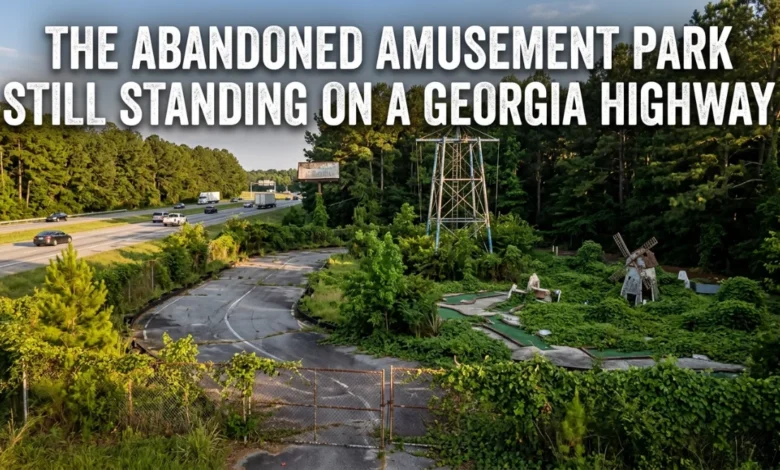
Drive north on Interstate 75 out of Macon, Georgia, take the Bass Road exit, and if you know where to look, you can still see it through the tree line: a low chain-link fence, a stretch of cracked asphalt shaped like a racetrack, and what used to be a mini-golf course now mostly reclaimed by kudzu and pine saplings. There’s a rusted metal frame back there too, tall enough to have once held something people paid money to jump off of. No sign marks the entrance anymore. Most drivers passing on Bass Road today have no idea what they’re looking at, or that it was ever anything at all.
It was Starcadia Entertainment Park, and for about a decade it was one of the only reasons anyone had to turn off that stretch of highway at all.
Macon’s North Side, Before the Boom
To understand why Starcadia exists, and why it failed, you have to understand what north Macon looked like in the late 1990s. Macon sits in Bibb County, in the middle of Georgia, an old railroad and textile city that had spent much of the twentieth century concentrated around its historic downtown and the Ocmulgee River. By the 1990s, growth was pushing north, out past the interstate, into land that was still mostly pasture and pine woods split by a two-lane road called Bass Road.
That was the landscape Beverly Knight Olsen was looking at in 1998 when she decided to build a small family amusement park on a stretch of that road. According to Olsen, in an interview years later with local station 13WMAZ, the land where she built it was untouched: “just pristine, it had never been touched before.” There was nothing else out there. No shopping centers, no restaurants, no other reason for a family to drive that direction unless they already lived nearby. Olsen was betting that people would come anyway, and for a while, they did.
What Starcadia Actually Was
Starcadia wasn’t a theme park in the Six Flags sense. It was a family entertainment center, the kind of place that existed in dozens of small and mid-sized American cities through the 1990s and 2000s, built around a menu of low-cost, high-turnover attractions rather than any single marquee ride. At Starcadia, that meant a go-kart track where visitors could drive small race cars around a paved loop, a full miniature golf course, batting cages, and an indoor arcade packed with the kind of ticket-redemption games that defined that era of family entertainment. Longtime visitors also remembered a water-based boat ride and a bungee-style jump attraction, a harness rig that let riders bounce several feet into the air and back down, along with a snack bar for the inevitable hot dogs and slushies that came with a full day out.
It was, by every account left behind on local message boards and social media groups, the kind of place built for a specific kind of afternoon: a kid’s birthday party, a school field trip, a Saturday with nothing else planned. One later description called it a favorite for children’s birthday parties specifically, the sort of venue a parent would book for a few hours of go-karts and cake rather than a full vacation destination. It didn’t need to be more than that. For years, out on that empty stretch of Bass Road, it was the only game in town.
Betting on a Highway That Hadn’t Arrived Yet
Being the only game in town, though, cut both ways. Starcadia opened before the rest of the corridor caught up to it, which meant Olsen spent years running a business that depended on drivers finding a destination with almost nothing around it to draw them off the interstate in the first place. Olsen has said it plainly: the location was hard for people to reach, and hard for people to remember was even there, unless they saw it advertised constantly. Being first has advantages. It also means there’s no foot traffic riding on anyone else’s coattails.
For a while, it looked like the gamble might pay off anyway. Around the middle of the 2000s, the kind of development Olsen had clearly been hoping for started arriving on that corridor: construction began on a Bass Pro Shops location across the road around 2005, a retail center called the Shoppes at River Crossing followed in 2007, and a Publix-anchored shopping center went up across the interstate around 2008, [VERIFY: exact opening years for Bass Pro Shops, the Shoppes at River Crossing, and the Publix center relative to Starcadia’s location]. A nearby business owner who opened a package store at the corner of Bass Road and what’s now called Starcadia Circle in 2007 said he’d hoped the big-box development would spread his way too, mentioning that a Target store had reportedly been planned for the land behind his shop before the deal fell through. It’s a familiar shape for anyone who has watched an American highway corridor develop: the growth comes, but it comes to the parcel next door, not the one you’re standing on.
The Year It Ended
Whatever momentum the surrounding development might have eventually brought to Starcadia itself never got the chance to show up. In 2008, the same year that Publix-anchored center broke ground nearby, the broader U.S. economy went into the financial crisis that would come to define that decade, and Starcadia’s finances did not survive it. A visitor posting on a Macon travel forum in March of that year reported that the park had gone out of business, describing it as a casualty of the recession that had been closed for several months already, with the owners saying they simply couldn’t keep it running any longer.
By most tellings, Starcadia had operated for roughly a decade, opening in 1998 and closing sometime around 2008 or 2009, [VERIFY: the precise month and year Starcadia Entertainment Park permanently closed]. Reports on the exact size of the property vary too. Some later writeups describe it as a six-acre park; a 2017 news report put the Starcadia parcel itself at ten acres, with more than forty additional acres nearby that Olsen had separately sold off, [VERIFY: exact acreage of the original Starcadia park versus the surrounding land Olsen owned and later sold]. What isn’t disputed is what happened to the land itself once the rides stopped running: nothing. No demolition crew came through. No new tenant moved in. The go-kart track, the mini-golf course, and the jump tower were simply left standing, exactly as they were the day the last customer walked out.
A Decade of Empty Asphalt
What followed was not a dramatic collapse but a long, quiet stretch of nothing happening at all, which in its own way is the more unsettling version of an abandoned place. There was no fire, no scandal, no headline-grabbing incident that shut Starcadia down overnight. It simply stopped making money, and once it did, the property sat exactly as it was while the world around it kept building.
Nature did what nature does to any unmaintained six-to-ten-acre lot in the Georgia climate: vines climbed the go-kart barriers, saplings pushed up through cracks in the batting cage concrete, and the mini-golf course, once landscaped and lit for evening play, turned into a low, uneven field of grass and volunteer trees. Urban explorers eventually found their way onto the property with cameras, and rare footage of the site, shot by a YouTube creator known online as BMW TEK, later circulated among Georgia history and roadside-oddity communities, giving people who’d never been able to place the name “Starcadia” their first real look at what remained. A separate documentary-style video, uploaded a few years later, framed the site as one of the more intact abandoned entertainment venues left standing in the Southeast, since so few closed amusement parks are left standing at all rather than bulldozed for redevelopment.
By 2017, according to that same 13WMAZ report, the surrounding street, by then officially named Starcadia Circle after the park that once anchored it, had only two operating businesses on it: a restaurant called J-Christopher and a church called Christ Chapel Macon. The forty-plus acres Olsen had sold off years earlier to a regional real estate company, Fickling & Company, had been cleared in anticipation of retail development that, as of that report, had still not materialized. Fickling representatives said they were still pursuing retailers for the site. Nothing was yet on paper.
Why Nobody Tore It Down
The most common question about Starcadia isn’t really “why did it close.” Small entertainment venues like it closed by the dozen across the country during the recession that started in 2008; Georgia alone lost several family-oriented parks and centers in roughly that same window, part of a wider national pattern in which land development, changing entertainment habits, and economic downturns have quietly closed something like a thousand amusement parks across North America over the past century. The more interesting question is why, more than a decade after it closed, the rides were still sitting there instead of being cleared for something new.
Part of the answer seems to be ordinary and unglamorous: land value and paperwork. Olsen reportedly still owned the ten-acre Starcadia parcel as of 2017, and she’d priced it at close to two and a half million dollars, a figure that may have simply been too high for a redevelopment project on a corridor that, despite the Bass Pro Shops and Publix nearby, hadn’t grown as fast or as far as she and other landowners on that stretch had once hoped. A property that expensive and that specific, built for one very particular former use, can sit through years of “for sale” signs without finding a buyer willing to take on the cost of clearing it. Olsen herself, according to that report, had come to accept that her own plans for the site were finished, saying only that she hoped someone else’s dream might eventually take root on the same ground, even if hers hadn’t lasted.
What’s Left Behind
What’s left today, for anyone willing to slow down on the Bass Road exit and actually look, is a kind of accidental time capsule. The go-kart track is still shaped like a go-kart track, even with grass growing through it. The frame that once held a bungee-jump harness still stands, stripped of whatever mechanism used to launch someone up into the air over a birthday party crowd. Somewhere in the overgrowth, the shape of a mini-golf course, with its low concrete borders and the ghost of a windmill obstacle or two, is probably still traceable if you know what you’re looking for, [VERIFY: whether specific mini-golf obstacles, such as a windmill feature, are still visibly intact on the property as of any recent visit].
None of it is dangerous or dramatic in the way abandoned places sometimes get built up to be online. There’s no unsolved death here, no disaster, no single tragic headline that explains the silence. What makes Starcadia worth pulling off the highway for, if you’re the kind of person who pulls off highways for things like this, is exactly how ordinary its ending was. A woman built a business on empty land, hoping the road around it would fill in fast enough to keep her afloat. Some of it did. Bass Pro Shops came. Publix came. A shopping center came. None of it came in time, or close enough, and the recession finished the job that geography had already made difficult. What’s left isn’t a mystery so much as a very literal, very physical record of that timing, sitting behind a fence off an interstate exit that thousands of drivers pass every single day without knowing it’s there.
Still Waiting, Off Bass Road
Macon itself has changed a great deal since Starcadia opened in 1998. The city consolidated its government with Bibb County in 2014, becoming Macon-Bibb County, [VERIFY: exact date and details of the Macon-Bibb County consolidation as it relates to this specific area], and the retail corridor along that stretch of I-75 has kept filling in with the kind of national chains Olsen once hoped would boost her own business rather than bypass it. Somewhere in the middle of all that growth, ten acres of cracked go-kart track and grown-over mini-golf greens are still sitting there, still privately owned, still waiting for either a buyer or a bulldozer.
Whether that land ever becomes something else, or simply keeps sitting there until the fence finally gives out and the trees finish the job the recession started, is an open question nobody connected to the property has answered publicly in years. For now, Starcadia remains exactly what it became the day the last go-kart rolled to a stop: a small, ordinary, unresolved piece of roadside Georgia, visible from the highway if you know when to look, and invisible to almost everyone else.